


Page 69 - analysis-and-interpretation-of-astronomical-sp
P. 69
Analysis and Interpretation of Astronomical Spectra                                    69

locity be equalised with the expansion speed of the spacetime . Applying the "classi-

cal" Doppler formula {18}              ), we obtain  47‘490 km s-1, i.e. almost 16% of

the speed of light! The corresponding value in the CDS Database [100] is               .

With the Hubble Law {21} the Distance results to about 600 Mpc or 2 bn ly. The accepted

value is slightly higher ~2.5 bn ly.

The huge redshift of 3C273 also shows why the current and future space telescopes (eg
Herschel, James Webb) are more and more optimised for the infrared range. In addition to
such considerations we should always be aware that the light, which we analyse today
from 3C273, was “on the road”, since 2.5 bn years when our earth was still in the Precam-
brian geological age! But anyway, compared with      for Abell 1835, this distance is

still relatively "close".

15.12 The Gravitational Redshift

Besides the classical Doppler effect and the relativistic spacetime expansion, it remains the
third option – the gravitational redshift. According to the General Theory of Relativity GTR,
light loses measurably energy as it propagates in an extreme gravitational field [431]. The
extreme case here are the black holes where the light is totally slowed down. In the spec-
troscopic amateur practice, however, already the much smaller gravitational field of white
dwarfs can massively distort the measurements of radial velocity! Anyway the average
value for this brake effect amounts in the spectral class DA to about 31 km/s [250]. The
corresponding, object-specific value must therefore be subtracted from the measured radial
velocity. For example, if for such a White Dwarf the radial velocity was measured to

                             , after the subtraction of gravitational redshift, it remains just
                    .

15.13 Short Excursus on "Hubble time" tH

In this case, it is worthwhile to take a small excursus, since the Hubble parameter allows in
a very simple way to estimate the approximate age of the universe! With the simplified as-
sumption of a constant expansion rate of the universe after the "Big Bang", by changing
formula {18}, it can be estimated, how long ago the entire matter was concentrated at “one
point”. This time span is also called Hubble time and is equal to the reciprocal of the
Hubble Parameter . This reciprocal value also corresponds to the Division of distance D by
the expansion velocity and thus the desired period of time !

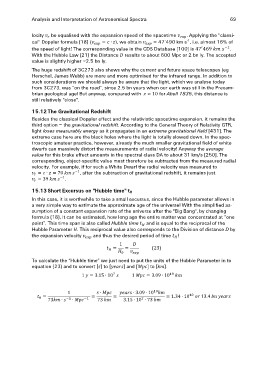
To calculate the “Hubble time” we just need to put the units of the Hubble Parameter in to
equation {23} and to convert [ ] to [  ] and         to [ ].

