


Page 73 - analysis-and-interpretation-of-astronomical-sp
P. 73
Analysis and Interpretation of Astronomical Spectra                                        73

16.6 The Rotation Velocity of the Stars

Due to the huge distances, with few exceptions, even with large telescopes, stars can’t be
seen as discs, but just as small Airy disks due to diffraction effects in optics. In this case the
above presented method therefore fails and remains reserved for 2-dimensional appearing
objects. Today, numerous methods exist for determining the rotational speed of stars, eg
with photometrically detected brightness variations or by means of interferometry. The idea
to gain the projected rotational velocity s from the spectrum is almost as old as the
spectroscopy itself.

William Abney has proposed already in 1877 to determine s analysing the rotationally
induced broadening of spectral lines. This phenomenon is also caused by the Doppler Ef-
fect, because the spectrum is composed of the light from the entire stellar surface, facing
us. The broadening and flattening of the lines, is created by the rotationally caused different
radial velocities of the individual surface
points. This so-called "rotational broadening"
is not the only effect that influences the

          of the spectral line (sect. 7.4). A suc-
cessful approach was to isolate the Doppler
Broadening-related share with various meth-
ods, eg by comparison with synthetically
modelled spectra or slowly rotating standard
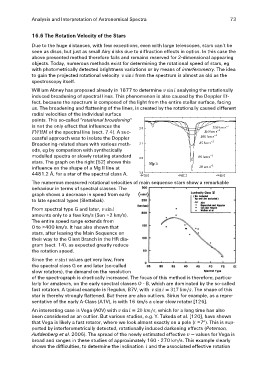
stars. The graph on the right [52] shows this
influence on the shape of a Mg II line at
4481.2 Å, for a star of the spectral class A.

The numerous measured rotational velocities of main sequence stars show a remarkable
behaviour in terms of spectral classes. The
graph shows a decrease in speed from early
to late spectral types (Slettebak).

From spectral type G and later, s
amounts only to a few km/s (Sun ~2 km/s).
The entire speed range extends from
0 to >400 km/s. It has also shown that
stars, after leaving the Main Sequence on
their way to the Giant Branch in the HR dia-
gram (sect. 14), as expected greatly reduce
the rotation speed.

Since the s values get very low, from
the spectral class G on and later (so-called
slow rotators), the demand on the resolution
of the spectrograph is drastically increased. The focus of this method is therefore, particu-
larly for amateurs, on the early spectral classes O - B, which are dominated by the so-called
fast rotators. A typical example is Regulus, B7V, with s  . The shape of this

star is thereby strongly flattened. But there are also outliers. Sirius for example, as a repre-

sentative of the early A-Class (A1V), is with 16 km/s a clear slow rotator [126].

An interesting case is Vega (A0V) with s             , which for a long time has also

been considered as an outlier. But various studies, e.g. Y. Takeda et al. [120], have shown
that Vega is likely a fast rotator, where we look almost exactly on a pole ( ≈7°). This is sup-

ported by interferometrically detected, rotationally induced darkening effects (Peterson,

Aufdenberg et al. 2006). The spread of the newly estimated effective values for Vega is

broad and ranges in these studies of approximately 160 - 270 km/s. This example clearly
shows the difficulties, to determine the inclination and the associated effective rotation

