


Page 71 - analysis-and-interpretation-of-astronomical-sp
P. 71
Analysis and Interpretation of Astronomical Spectra                                                                                                                         71

16.3 The Rotation Velocity of the Sun

This method allows also the estimation of the Sun’s rotational surface speed, of course
with an attached energy filter (!). This velocity however is so low (~1.9 km/s), that a high
resolution spectrograph is required. In this case, the picture of the Sun on the slit plate
would be too large, respectively the slit much too short to cover the entire solar equator.

Required in such cases is the recording of two separate wavelength-calibrated spectra,
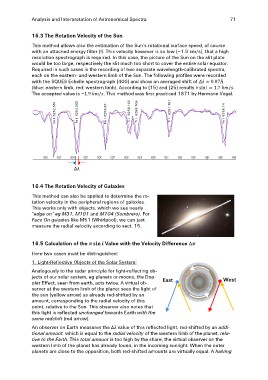
each on the eastern- and western limb of the Sun. The following profiles were recorded

with the SQUES Echelle spectrograph [400] and show an averaged shift of

(blue: eastern limb, red: western limb). According to {15} and {25} results s                                                                                               .

The accepted value is ~  . This method was first practiced 1871 by Hermann Vogel.

Fe I 6252.561
                     Fe I 6254.262
                                               Fe I 6256.37
                                                                      Ti I 6258.103
                                                                             Ti I 6258.706
                                                                                                            Ti I 6261.101
                                                                                                                                                              Fe I 6265.14

Δλ

16.4 The Rotation Velocity of Galaxies

This method can also be applied to determine the ro-
tation velocity in the peripheral regions of galaxies.
This works only with objects, which we see nearly
“edge on” eg M31, M101 and M104 (Sombrero). For
Face On galaxies like M51 (Whirlpool), we can just
measure the radial velocity according to sect. 15.

16.5 Calculation of the  Value with the Velocity Difference

Here two cases must be distinguished:

1. Light-Reflective Objects of the Solar System:

Analogously to the radar principle for light-reflecting ob-  EaOsstt           West
jects of our solar system, eg planets or moons, the Dop-
pler Effect, seen from earth, acts twice. A virtual ob-
server at the western limb of the planet sees the light of
the sun (yellow arrow) as already red-shifted by an
amount, corresponding to the radial velocity of this
point, relative to the Sun. This observer also notes that
this light is reflected unchanged towards Earth with the
same redshift (red arrow).

An observer on Earth measures the value of this reflected light, red-shifted by an addi-
tional amount, which is equal to the radial velocity of the western limb of the planet, rela-
tive to the Earth. This total amount is too high by the share, the virtual observer on the

western limb of the planet has already found, in the incoming sunlight. When the outer
planets are close to the opposition, both red-shifted amounts are virtually equal. A halving

