


Page 74 - analysis-and-interpretation-of-astronomical-sp
P. 74
Analysis and Interpretation of Astronomical Spectra                                       74

velocity , – this compared with the relatively simply determinable s value! Today the
          - Method is complemented e.g. by a Fourier analysis of the line profile. The first

minimum point represents here the value for s with a resolution of some 2 km/s [125].
This method requires high-resolution spectra.

Various studies have shown, that the orientation of the stellar rotation axes is randomly dis-
tributed – in contrast to most of the planets in our solar system axes. Since the effective
equatorial velocity can be determined only in exceptional cases, the research is here limited
almost exclusively on statistical methods, based on extensive s - samples. Most ama-
teurs will probably limit themselves to reproduce well known literature values with high ro-
tation velocities, typically for the earlier spectral classes.

Empirical Formulas for s depending on            ,s =

A considerable number of astrophysical publications in the SAO/NASA database (~1920 to
the presence) deal with the calibration of the rotational speed, relative to FWHM. Some of
the numerous "protagonists" are here A. Slettebak, O. Struve, G. Shajn, F. Royer and F. Fe-
kel. Probably the most cited standard work in this respect is the so called „New Slettebak

System“ from 1975. Anyway recent studies have shown that the provided s values are
systematically too low. That's why I present here more recent approaches. The variable in
most such formulas is       , given in [Å] {3}. But in some formulas            is also

expressed as a Doppler velocity [km/s]. In one case, also the Equivalent Width EW [Å] is in-
volved (sect. 7).

The Method according to F. Fekel

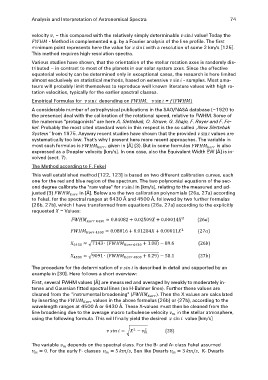
This well established method [122, 123] is based on two different calibration curves, each
one for the red and blue region of the spectrum. The two polynomial equations of the sec-
ond degree calibrate the "raw value" for s in [km/s], relating to the measured and ad-
justed {3}         in [Å]. Below are the two calibration polynomials {26a, 27a} according

to Fekel, for the spectral ranges at 6430 Å and 4500 Å, followed by two further formulas
{26b, 27b}, which I have transformed from equations {26a, 27a} according to the explicitly
requested – Values:

The procedure for the determination of        is described in detail and supported by an

example in [30]. Here follows a short overview:

First, several FWHM values [Å] are measured and averaged by weakly to moderately in-
tense and Gaussian fitted spectral lines (no H-Balmer lines). Further these values are
cleaned from the "instrumental broadening" (         ). Then the X values are calculated

by inserting the       values in the above formulas {26b} or {27b}, according to the

wavelength ranges at 4500 Å or 6430 Å. These X-values must then be cleaned from the
line broadening due to the average macro turbulence velocity in the stellar atmosphere,

using the following formula. This will finally yield the desired  value [km/s]

The variable depends on the spectral class. For the B- and A- class Fekel assumed

. For the early F- classes              , Sun like Dwarfs             , K- Dwarfs

