


Page 78 - analysis-and-interpretation-of-astronomical-sp
P. 78
Analysis and Interpretation of Astronomical Spectra                                           78

According to Miroshnichenko [141] and Hanuschik [143] a decreasing disk radius R is also
associated with, an increasing       . This statement is consistent with formula {33}

and {34}.

The outer disc radius                                                 Rs
                                                                          r
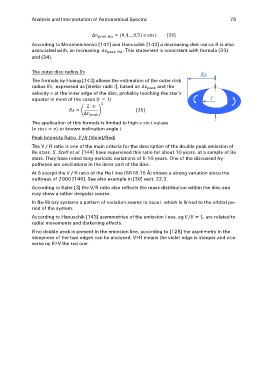
The formula by Huang [143] allows the estimation of the outer disk
radius , expressed as [stellar radii r], based on    and the

velocity at the inner edge of the disc, probably touching the star’s

equator in most of the cases ( ).                                          <

The application of this formula is limited to high   values
( or known inclination angle .

Peak Intensity Ratio   (Violet/Red)

The V / R ratio is one of the main criteria for the description of the double peak emission of
Be stars. S. Stefl et al. [144] have supervised this ratio for about 10 years, at a sample of Be
stars. They have noted long-periodic variations of 5-10 years. One of the discussed hy-
potheses are oscillations in the inner part of the disk.

At δ scorpii the V / R ratio of the He I line (6678.15 Å) shows a strong variation since the
outbreak of 2000 [146]. See also example in [30] sect. 22.3.

According to Kaler [3] the V/R ratio also reflects the mass distribution within the disc and
may show a rather irregular course.

In Be-Binary systems a pattern of variation seems to occur, which is linked to the orbital pe-
riod of the system.

According to Hanuschik [143] asymmetries of the emission lines, eg    , are related to
radial movements and darkening effects.

If no double peak is present in the emission line, according to [128] the asymmetry in the
steepness of the two edges can be analysed. V>R means the violet edge is steeper and vice
versa by R>V the red one.

