


Page 112 - spectroscopic-atlas-5_0-english_Neat
P. 112
Spectroscopic Atlas for Amateur Astronomers                                                    112

WD 0413 –077: 40 Eridani B       Spectral class DAP 3.1         Distance 16 ly

J2000 RA: 04h 15' 22" Dec: –07° 39' 29" mV = 9.5m

Here again, the strongly broadened hydrogen lines are the most prominent spectral feature.

The equivalent width of the Hβ line is here with 78Å even about 3x as large as by the any-

way impressive absorptions of the main sequence star A1Vm Sirius (27 Å). Compared to

WD 0644 +375 this is caused here by the lower temperature of 40 Eridani B, which fa-

vours this type of absorption and may be estimated, in accordance with the classification

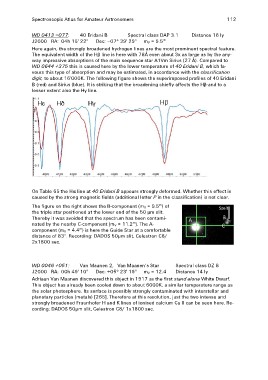
digit, to about 16'000K. The following figure shows the superimposed profiles of 40 Eridani

B (red) and Sirius (blue). It is striking that the broadening chiefly affects the Hβ-and to a

lesser extent also the Hγ line.

On Table 65 the Hα line at 40 Eridani B appears strongly deformed. Whether this effect is
caused by the strong magnetic fields (additional letter P in the classification) is not clear.

The figure on the right shows the B-component (mV = 9.5m) of    A                    Spalt
the triple star positioned at the lower end of the 50 μm slit.
                                                                                      B
Thereby it was avoided that the spectrum has been contami-                            C
nated by the nearby C-component (mV = 11.2m). The A-
component (mV = 4.4m) is here the Guide Star at a comfortable
distance of 83". Recording: DADOS 50μm slit, Celestron C8/

2x1800 sec.

WD 0046 +051: Van Maanen 2, Van Maanen‘s Star                   Spectral class DZ 8

J2000 RA: 00h 49' 10" Dec: +05° 23' 19" mV = 12.4 Distance 14 ly

Adriaan Van Maanen discovered this object in 1917 as the first stand alone White Dwarf.

This object has already been cooled down to about 6000K, a similar temperature range as

the solar photosphere. Its surface is possibly strongly contaminated with interstellar and

planetary particles (metals) [265]. Therefore at this resolution, just the two intense and

strongly broadened Fraunhofer H and K lines of ionised calcium Ca II can be seen here. Re-

cording: DADOS 50μm slit, Celestron C8/ 1x1800 sec.

