


Page 116 - spectroscopic-atlas-5_0-english_Neat
P. 116
Spectroscopic Atlas for Amateur Astronomers                                                 116

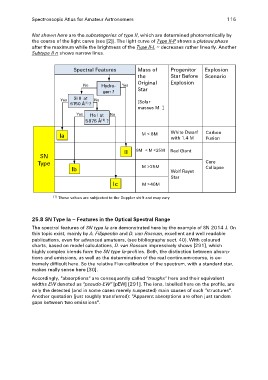
Not shown here are the subcategories of type II, which are determined photometrically by
the course of the light curve (see [2]). The light curve of Type II-P shows a plateau phase
after the maximum while the brightness of the Type II-L ~ decreases rather linearly. Another
Subtype II n shows narrow lines.

          Spectral Features                  Mass of                    Progenitor Explosion
                                             the                        Star Before Scenario
                    No Hydro-           Yes  Original                   Explosion
                                 gen ?       Star

      Yes Si II at No                        [Solar
            6150 Å(1) ?
                                             masses M☉]

          Yes He I at No
               5876 Å(1) ?

      Ia                                     M < 8M☉                    White Dwarf Carbon

                                                                        with 1.4 M☉ Fusion

 SN                II 8M☉< M <25M☉ Red Giant                            Core
Type                                                                    Collapse
                           M >25M☉
          Ib
                                                  Wolf Rayet
                                                  Star

              Ic M >40M☉

      (1) These values are subjected to the Doppler shift and may vary

25.8 SN Type Ia – Features in the Optical Spectral Range

The spectral features of SN type Ia are demonstrated here by the example of SN 2014 J. On
this topic exist, mainly by A. Filippenko and D. van Rossum, excellent and well readable
publications, even for advanced amateurs, (see bibliography sect. 40). With coloured
charts, based on model calculations, D. van Rossum impressively shows [291], which
highly complex blends form the SN type Ia-profiles. Both, the distinction between absorp-
tions and emissions, as well as the determination of the real continuum-course, is ex-
tremely difficult here. So the relative Flux-calibration of the spectrum, with a standard star,
makes really sense here [30].

Accordingly, "absorptions" are consequently called "troughs" here and their equivalent
widths EW denoted as "pseudo-EW" [pEW] [291]. The ions, labelled here on the profile, are
only the detected (and in some cases merely suspected) main causes of such "structures".
Another quotation (just roughly transferred): "Apparent absorptions are often just random
gaps between two emissions".

