


Page 117 - spectroscopic-atlas-5_0-english_Neat
P. 117
Spectroscopic Atlas for Amateur Astronomers 117
Table 67: SN 2014 J, Type Ia, Host Galaxy M82
SN 2014 J was since decades the brightest super-
nova and reached about January 30th, 2014, the
maximum apparent brightness of mV = +10.5. It
was discovered by chance and surprisingly late not
until January 21st, on the occasion of a student
exercise at the University of London. The apparent
explosion date was subsequently determined from
pictures, taken by automatic surveillance systems,
to January 14th 2014 [292].
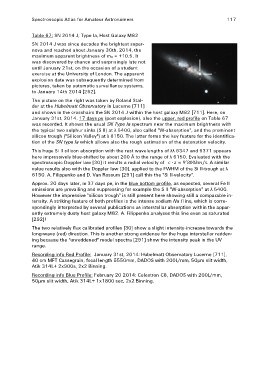
The picture on the right was taken by Roland Stal-
der at the Hubelmatt Observatory in Lucerne [711]
and shows in the crosshairs the SN 2014 J within the host galaxy M82 [711]. Here, on
January 31st, 2014, 17 days pe (post explosion), also the upper, red profile on Table 67
was recorded. It shows the usual SN Type Ia spectrum near the maximum brightness with
the typical two sulphur sinks (S II) at λ 5400, also called "W-absorption", and the prominent
silicon trough ("Silicon Valley") at λ 6150. The latter forms the key feature for the identifica-
tion of the SN type Ia which allows also the rough estimation of the detonation velocity.
This huge Si II silicon absorption with the rest wavelengths of λλ 6347 and 6371 appears
here impressively blue-shifted by about 200 Å to the range of λ 6150. Evaluated with the
spectroscopic Doppler law [30] it results a radial velocity of ܿ ∙ ≈ ݖ9ᇱ800݇݉/ݏ. A similar
value results also with the Doppler law [30], applied to the FWHM of the Si II-trough at λ
6150. A. Filippenko and D. Van Rossum [291] call this the "Si II-velocity".
Approx. 20 days later, ie 37 days pe, in the blue bottom profile, as expected, several Fe II
emissions are prevailing and suppressing for example the S II "W-absorption" at λ 5400.
However the impressive "silicon trough" is still present here showing still a comparable in-
tensity. A striking feature of both profiles is the intense sodium Na I line, which is corre-
spondingly interpreted by several publications as interstellar absorption within the appar-
ently extremely dusty host galaxy M82. A. Filippenko analyses this line even as saturated
[292]!
The two relatively flux calibrated profiles [30] show a slight intensity-increase towards the
long-wave (red) direction. This is another strong evidence for the huge interstellar redden-
ing because the "unreddened" model spectra [291] show the intensity peak in the UV
range.
Recording info Red Profile: January 31st, 2014: Hubelmatt Observatory Lucerne [711],
40 cm MFT Cassegrain, focal length 5550mm, DADOS with 200L/mm, 50μm slit width,
Atik 314L+ 2x900s, 2x2 Binning.
Recording info Blue Profile: February 20 2014: Celestron C8, DADOS with 200L/mm,
50μm slit width, Atik 314L+ 1x1800 sec, 2x2 Binning.

