


Page 114 - spectroscopic-atlas-5_0-english_Neat
P. 114
Spectroscopic Atlas for Amateur Astronomers  114

25 Supernovae

25.1 Phenomenon of Supernova Explosion SN

A supernova explosion totally destroys the star and
forms the definitive end point in its life. By this
cataclysmic runaway reaction an unimaginable
amount of energy is set free and almost the entire
stellar mass, initially with> 10,000 km/s, is distrib-
uted to the surrounding space. For comparison: the
detonation velocity of our most rapid explosives just
reaches ~ 8km / s (Nitropenta). As a result of such
an explosion, the interstellar matter (ISM) is en-
riched with heavy elements, which decisively influ-
ences the later formation of stars, planets and fi-
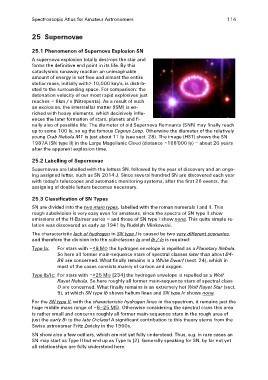
nally also of possible life. The diameter of old Supernova Remnants (SNR) may finally reach
up to some 100 ly, so eg the famous Cygnus Loop. Otherwise the diameter of the relatively
young Crab Nebula M1 is just about 11 ly (see sect. 28). The image (HST) shows the SN
1987A (SN type II) in the Large Magellanic Cloud (distance ~168'000 ly) – about 20 years
after the apparent explosion time.

25.2 Labelling of Supernovae

Supernovae are labelled with the letters SN, followed by the year of discovery and an ongo-
ing assigned letter, such as SN 2014 J. Since several hundred SN are discovered each year
with today's telescopes and automatic monitoring systems, after the first 26 events, the
assigning of double letters becomes necessary.

25.3 Classification of SN Types

SN are divided into the two main types, labelled with the roman numerals I and II. This
rough subdivision is very easy even for amateurs, since the spectra of SN type II show
emissions of the H-Balmer series – and those of SN type I show none. This quite simple re-
lation was discovered as early as 1941 by Rudolph Minkowski.

The characteristic lack of hydrogen in SN type I is caused by two very different scenarios,
and therefore the division into the sub-classes Ia and Ib / Ic is required:

Type Ia:  For stars with ~<8 M the hydrogen envelope is repelled as a Planetary Nebula.
          So here all former main-sequence stars of spectral classes later than about B4-
          B6 are concerned. What finally remains is a White Dwarf (sect. 24), which in
          most of the cases consists mainly of carbon and oxygen.

Type Ib/Ic: For stars with ~>25 M [234] the hydrogen envelope is repelled as a Wolf
               Rayet Nebula. So here roughly all former main-sequence stars of spectral class
               O are concerned. What finally remains is an extremely hot Wolf Rayet Star (sect.
               9), at which SN type Ib shows helium lines and SN type Ic shows none.

For the SN type II, with the characteristic hydrogen lines in the spectrum, it remains just the
huge middle mass range of ~8–25 M . Otherwise considering the spectral class this area
is rather small and concerns roughly all former main-sequence stars in the rough area of
just the early B- to the late O-class! A significant contribution to this theory stems from the
Swiss astronomer Fritz Zwicky in the 1960s.

SN show also a few outliers, which are not yet fully understood. Thus, e.g. in rare cases an
SN may start as Type II but end up as Type Ic [2]. Generally speaking for SN, by far not yet
all relationships are fully understood here.

