


Page 97 - spectroscopic-atlas-5_0-english_Neat
P. 97
Spectroscopic Atlas for Amateur Astronomers                                                97

22 Spectral Class S on the AGB

22.1 Overview and Spectral Characteristics

The spectrum of a star is influenced on the further ascent along the AGB by:

– the increase of carbon in the stellar atmosphere
– the consequential decline of the oxygen content
– “dredged up” S–process products (eg, zirconium, lithium, etc.)

This development changes at first the spectral type M(e) in to the intermediate class MS. If
at all, then only small differences are detectable here with moderate resolution spectro-
graphs. However at higher resolution appear first signs of zirconium oxide (ZrO). within the
still dominant titanium oxide bands. The share of ZrO increases now continuously up to the
extreme types of the spectral class S, where ZrO almost entirely replaces the TiO absorp-
tion. In [2] this effect is explained with the higher affinity of ZrO to oxygen, and the greater
temperature resistance of this molecule. The dissociation energy of ZrO, (and also of LaO
and YO), is >7eV, in contrast to TiO <7eV.

22.2 The Boeshaar – Keenan S–Classification System

The spectral class S is specified with the following format. It forms a temperature se-
quence, analog to the normal M-giants on the RGB. Since all S-stars are already giants, a
luminosity class is usually not indicated.

                                     SX/n(e)

X: stands for the temperature sequence of the M-class from 1 – 9 (some 3,800–2,500 K).
n: C/O index on a scale of 1 – 10, estimated from the relative intensities of TiO and ZrO.

    The C/O ratio itself can't be obtained directly from the spectrum. It can only be
    estimated by means of the C/O index (table values according to Scalo, Ross)
(e) indicates that the spectrum sometimes shows emission lines.

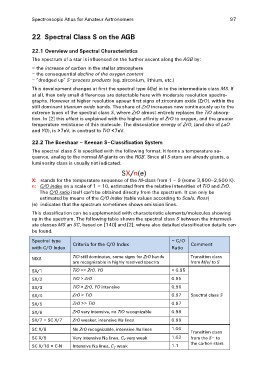
This classification can be supplemented with characteristic elements/molecules showing
up in the spectrum. The following table shows the spectral class S between the intermedi-
ate classes MS an SC, based on [140] and [2], where also detailed classification details can
be found.

Spectral type                                                 ~ C/O
                        Criteria for the C/O Index                       Comment

with C/O Index                                                Ratio

MXS            TiO still dominates, some signs for ZrO bands          Transition class
               are recognisable in highly resolved spectra            from M(e) to S
SX/1           TiO >> ZrO, YO
SX/2           TiO > ZrO                                      < 0.95
SX/3           TiO ≈ ZrO, YO intensive
SX/4           ZrO > TiO                                      0.95
SX/5           ZrO >> TiO
SX/6           ZrO very intensive, no TiO recognizable        0.96
SX/7 = SC X/7  ZrO weaker, intensive Na lines
SC X/8                                                        0.97 Spectral class S
SC X/9         No ZrO recognizable, intensive Na lines
SC X/10 = C-N  Very intensive Na lines, C2 very weak          0.97
               Intensive Na lines, C2 weak
                                                              0.98

                                                              0.99

                                                              1.00    Transition class
                                                              1.02    from the S– to
                                                              1.1     the carbon stars

