


Page 95 - spectroscopic-atlas-5_0-english_Neat
P. 95
Spectroscopic Atlas for Amateur Astronomers 95
21 M(e) Stars on the AGB
21.1 Overview
The unstable M(e) stars on the AGB still have an oxygen-rich atmosphere (ܥ⁄ܱ < 1) and are
usually long-period variable of type LPV (Long Period Variable) or Mira Variable. The period
of the brightness variation is in the order of about 100 to 1000 days. Prototype of this class
is Mira (ο Ceti). This instability leads to shock waves in the stellar atmosphere, which ex-
pands and contracts by the rhythm of the brightness variations (radius up to a factor 2!).
As a result of this spectacular process the star loses continuously matter, as documented
by recent photographs of Mira. The star produces on its way through the galaxy an impres-
sive trace of stellar material, which can be seen in the ultraviolet region on a length of
about 13 ly. This spectacular image was taken with GALEX (Galaxy Evolution Explorer,
NASA), recorded in August 2008: http://www.nasa.gov/mission_pages/galex/.
21.2 Spectral Characteristics of the M(e) Stars on the AGB
Parallel to the "pulsations" of the stellar atmosphere, emission lines of variable intensity
appear in the spectrum, predominantly the short wave H–Balmer lines on the “blue side” of
Hγ. The maximum intensity mostly shows Hδ (see Table 59). According to the Balmer dec-
rement the Hα, Hβ and Hγ emissions are in fact much more intensive. But highly intense TiO
absorption bands overprint here completely Hα and Hβ and strongly diminish Hγ. According
to [1] this is evidence that the emission lines are formed in much deeper layers of the stel-
lar atmosphere as the titanium oxide absorptions. The spectral type of the star itself is often
variable within the range of decimal subclasses. Apart from the emission lines no further
differences to a normal M- star can be detected in a moderately resolved spectrum.
21.3 Commented Spectra
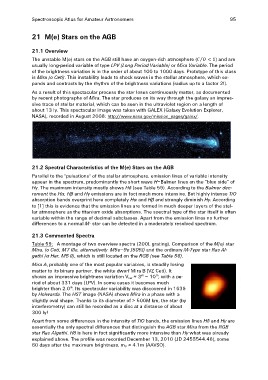
Table 59: A montage of two overview spectra (200L grating). Comparison of the M(e) star
Mira, (o Ceti, M7 IIIe, alternatively M5e–9e [505]) and the ordinary M-Type star Ras Al-
gethi (α Her, M5 II), which is still located on the RGB (see Table 56).
Mira A, probably one of the most popular variables, is steadily losing
matter to its binary partner, the white dwarf Mira B (VZ Ceti). It
shows an impressive brightness variation Vvar ≈ 3m – 10m, with a pe-
riod of about 331 days (LPV). In some cases it becomes much
brighter than 2.0m. Its spectacular variability was discovered in 1639
by Holwarda. The HST image (NASA) shows Mira in a phase with a
slightly oval shape. Thanks to its diameter of > 500M km, the star (by
interferometry) can still be recorded as a disc at a distance of about
300 ly!
Apart from some differences in the intensity of TiO bands, the emission lines Hδ and Hγ are
essentially the only spectral differences that distinguish the AGB star Mira from the RGB
star Ras Algethi. Hδ is here in fact significantly more intensive than Hγ what was already
explained above. The profile was recorded December 13, 2010 (JD 2455544.46), some
60 days after the maximum brightness, mV ≈ 4.1m (AAVSO).

