


Page 94 - spectroscopic-atlas-5_0-english_Neat
P. 94
Spectroscopic Atlas for Amateur Astronomers 94
20.2 The Spectral Sequence of the Mira Variables on the AGB
This sequence consists of stars in their unstable AGB phase, limited to the range of about
1 – 2 solar masses and the spectral class M as well as to some late K-types. This category
is for amateur astronomers not only interesting for photometric monitoring, but also in
terms of spectral analysis. The astrophysical context is still not fully understood and shown
here strongly simplified, mainly based on [2].
Once arrived on the AGB the star becomes unstable, as a result of the above mentioned
complex fusion processes. It starts now pulsating and pushing off a lot of material. There-
fore most but not all of these stars, show now the behaviour of long-period Mira Variables.
Current theories postulate at this stage strong, so-called Thermal Pulses, which trigger
deep convective "dredge up" processes inside the star. As a result, carbon, and products of
the nuclear S–process, is conveyed to the stellar surface (e.g. barium, lithium, zirconium,
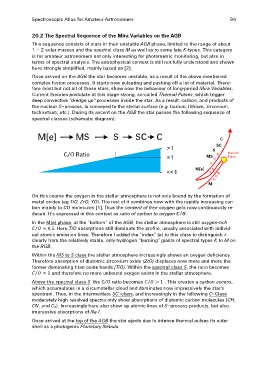
technetium, etc.). During its ascent on the AGB the star passes the following sequence of
spectral classes (schematic diagram):
M[e] MS S SC C C Helium
Flash
C/O Ratio >1 SC
≈1 S
MS
<<1 M[e]
M
On this course the oxygen in the stellar atmosphere is not only bound by the formation of
metal oxides (eg TiO, ZrO, YO). The rest of it combines now with the rapidly increasing car-
bon mainly to CO molecules [1]. Thus the content of free oxygen gets now continuously re-
duced. It’s expressed in this context as ratio of carbon to oxygen ⁄ࡻ.
In the M(e) phase, at the “bottom” of the AGB, the stellar atmosphere is still oxygen-rich
ܥ⁄ܱ ≈ 0.5. Here TiO absorptions still dominate the profile, usually associated with individ-
ual atomic emission lines. Therefore I added the “index” (e) to this class to distinguish it
clearly from the relatively stable, only hydrogen “burning” giants of spectral types K to M on
the RGB.
Within the MS to S class the stellar atmosphere increasingly shows an oxygen deficiency.
Therefore absorption of diatomic zirconium oxide (ZrO) displaces now more and more the
former dominating titan oxide bands (TiO). Within the spectral class S, the ratio becomes
ܥ⁄ܱ ≈ 1 and therefore no more unbound oxygen exists in the stellar atmosphere.
Above the spectral class S the C/O ratio becomes ܥ⁄ܱ > 1 . This creates a carbon excess,
which accumulates in a circumstellar cloud and dominates now impressively the star's
spectrum. Thus, in the intermediate SC -class, and increasingly in the following C- Class
moderately high resolved spectra only show absorptions of diatomic carbon molecules (CH,
CN, and C2). Increasingly here also show up atomic lines of S–process products, but also
impressive absorptions of Na I.
Once arrived at the top of the AGB the star ejects due to intense thermal pulses its outer
shell as a photogenic Planetary Nebula.

