


Page 23 - Super Earth Encyclopedia
P. 23
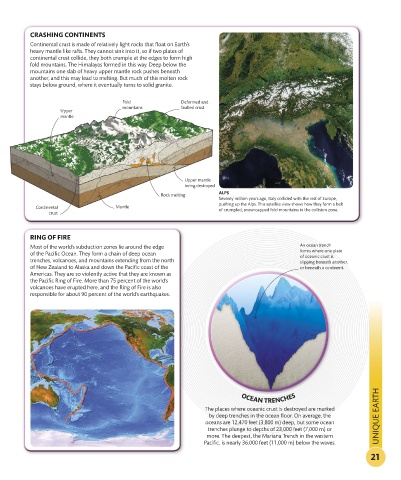
CRASHING CONTINENTS
            Continental crust is made of relatively light rocks that float on Earth’s
            heavy mantle like rafts. They cannot sink into it, so if two plates of
            continental crust collide, they both crumple at the edges to form high
            fold mountains. The Himalayas formed in this way. Deep below the
            mountains one slab of heavy upper mantle rock pushes beneath
            another, and this may lead to melting. But much of this molten rock
            stays below ground, where it eventually turns to solid granite.


                                             Fold                 Deformed and
                                             mountains            faulted crust
                       Upper
                       mantle


                                                                   Upper mantle
                                                                   being destroyed
                                                                               ALPS
                                                          Rock melting
                                                                               Seventy million years ago, Italy collided with the rest of Europe,
                                                                               pushing up the Alps. This satellite view shows how they form a belt
              Continental                 Mantle                               of crumpled, snow-capped fold mountains in the collision zone.
                  crust


            RING OF FIRE
            Most of the world’s subduction zones lie around the edge                                        An ocean trench
            of the Pacific Ocean. They form a chain of deep ocean                                           forms where one plate
                                                                                                            of oceanic crust is
            trenches, volcanoes, and mountains extending from the north                                     slipping beneath another,
            of New Zealand to Alaska and down the Pacific coast of the                                      or beneath a continent.
            Americas. They are so violently active that they are known as
            the Pacific Ring of Fire. More than 75 percent of the world’s
            volcanoes have erupted here, and the Ring of Fire is also
            responsible for about 90 percent of the world’s earthquakes.


                                                                                       OCEAN TRENCHES

                                                                          The places where oceanic crust is destroyed are marked
                                                                           by deep trenches in the ocean floor. On average, the         UNIQUE EARTH
                                                                          oceans are 12,470 feet (3,800 m) deep, but some ocean
                                                                           trenches plunge to depths of 23,000 feet (7,000 m) or
                                                                           more. The deepest, the Mariana Trench in the western
                                                                          Pacific, is nearly 36,000 feet (11,000 m) below the waves.
                                                                                                                                     21


   US_020-021_Collision_Zones.indd   21                                                                                             01/03/17   12:25 pm

