


Page 26 - Super Earth Encyclopedia
P. 26
EARTHQUAKES


          Nearly all earthquakes occur on the boundaries
          between the mobile plates of Earth’s crust. These
          plates are always moving, but the boundaries rarely
          move at the same steady rate. The rocks become
          locked together, and the strain builds up until
          they suddenly give way, causing an earthquake.
          If this happens on the seabed, it can
          trigger a tsunami.


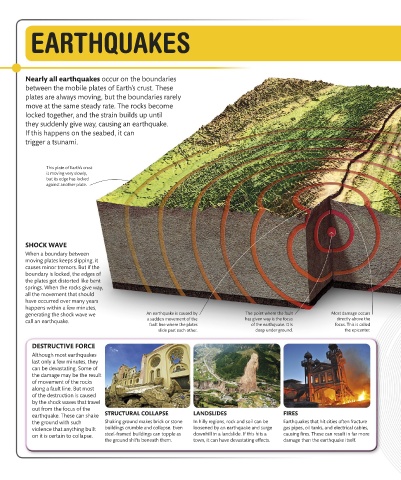
                  This plate of Earth’s crust
                  is moving very slowly,
                  but its edge has locked
                  against another plate.


          SHOCK WAVE
          When a boundary between
          moving plates keeps slipping, it
          causes minor tremors. But if the
          boundary is locked, the edges of
          the plates get distorted like bent
          springs. When the rocks give way,
          all the movement that should
          have occurred over many years
          happens within a few minutes,
          generating the shock wave we               An earthquake is caused by          The point where the fault     Most damage occurs
          call an earthquake.                        a sudden movement of the           has given way is the focus       directly above the
                                                      fault line where the plates          of the earthquake. It is     focus. This is called
                                                         slide past each other.             deep under ground.              the epicenter.

            DESTRUCTIVE FORCE
            Although most earthquakes
            last only a few minutes, they
            can be devastating. Some of
            the damage may be the result
            of movement of the rocks
            along a fault line. But most
            of the destruction is caused
            by the shock waves that travel
            out from the focus of the
            earthquake. These can shake   STRUCTURAL COLLAPSE         LANDSLIDES                      FIRES
            the ground with such      Shaking ground makes brick or stone   In hilly regions, rock and soil can be   Earthquakes that hit cities often fracture
            violence that anything built   buildings crumble and collapse. Even   loosened by an earthquake and surge   gas pipes, oil tanks, and electrical cables,
            on it is certain to collapse.   steel-framed buildings can topple as    downhill in a landslide. If this hits a   causing fires. These can result in far more
                                      the ground shifts beneath them.  town, it can have devastating effects.  damage than the earthquake itself.


   US_024-025_Earthquake.indd   24                                                                                                   14/03/17   3:35 pm

