


Page 35 - Super Earth Encyclopedia
P. 35
FOSSILS
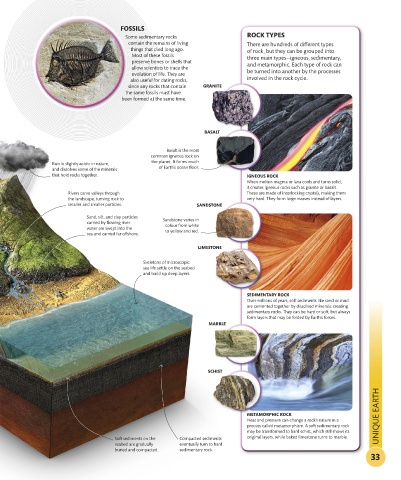
                                              Some sedimentary rocks                     ROCK TYPES
                                               contain the remains of living             There are hundreds of different types
                                                things that died long ago.               of rock, but they can be grouped into
                                                Most of these fossils                    three main types—igneous, sedimentary,
                                                preserve bones or shells that            and metamorphic. Each type of rock can
                                                allow scientists to trace the
                                                evolution of life. They are              be turned into another by the processes
                                                also useful for dating rocks,            involved in the rock cycle.
                                               since any rocks that contain   GRANITE
                                              the same fossils must have
                                            been formed at the same time.


                                                                          BASALT


                                                            Basalt is the most
                                                       common igneous rock on
                    Rain is slightly acidic in nature,    the planet. It forms much
                    and dissolves some of the minerals    of Earth’s ocean floor.
                    that hold rocks together.                                            IGNEOUS ROCK
                                                                                         When molten magma or lava cools and turns solid,
                                                                                         it creates igneous rocks such as granite or basalt.
                         Rivers carve valleys through                                    These are made of interlocking crystals, making them
                         the landscape, turning rock to                                  very hard. They form large masses instead of layers.
                         smaller and smaller particles.                SANDSTONE

                                Sand, silt, and clay particles   Sandstone varies in
                                carried by flowing river    colour from white
                                water are swept into the    to yellow and red.
                                sea and carried far offshore.

                                                                        LIMESTONE


                                                    Skeletons of microscopic
                                                    sea life settle on the seabed
                                                    and build up deep layers.


                                                                                         SEDIMENTARY ROCK
                                                                                         Over millions of years, soft sediments like sand or mud
                                                                                         are cemented together by dissolved minerals, creating
                                                                                         sedimentary rocks. They can be hard or soft, but always
                                                                                         form layers that may be folded by Earth’s forces.
                                                                           MARBLE


                                                                           SCHIST


                                                                                                                                        UNIQUE EARTH


                                                                                         METAMORPHIC ROCK
                                                                                         Heat and pressure can change a rock’s nature in a
                                                                                         process called metamorphism. A soft sedimentary rock
                                                                                         may be transformed to hard schist, which still shows its
                                          Soft sediments on the   Compacted sediments    original layers, while baked limestone turns to marble.
                                          seabed are gradually   eventually turn to hard
                                          buried and compacted.  sedimentary rock.
                                                                                                                                     33


   US_032-033_Rocky_planet.indd   33                                                                                                 01/03/17   1:38 pm

