


Page 30 - Super Earth Encyclopedia
P. 30
SUPERHEATED WATER


          Volcanoes are the most dramatic features of Earth’s
          tectonic plate boundaries and hotspots. But molten
          rock rising through the crust can also heat water that
          has seeped into the ground. Since hot water tends to
          rise, it finds its way back to the surface, where it erupts
          as hot springs, geysers, and other geothermal features.
          Unlike most volcanoes, they are often constantly active.

          HIGH PRESSURE

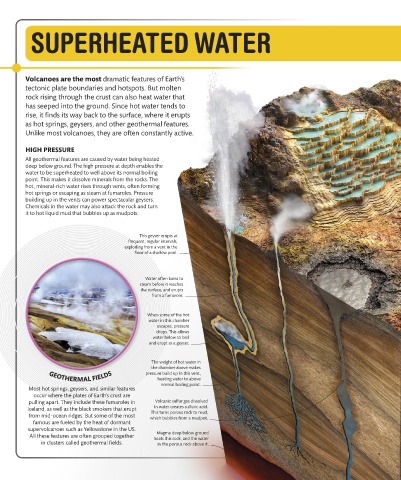
          All geothermal features are caused by water being heated
          deep below ground. The high pressure at depth enables the
          water to be superheated to well above its normal boiling
          point. This makes it dissolve minerals from the rocks. The
          hot, mineral-rich water rises through vents, often forming
          hot springs or escaping as steam at fumaroles. Pressure
          building up in the vents can power spectacular geysers.
          Chemicals in the water may also attack the rock and turn
          it to hot liquid mud that bubbles up as mudpots.


                                                   This geyser erupts at
                                               frequent, regular intervals,
                                             exploding from a vent in the
                                                 floor of a shallow pool.


                                                     Water often turns to
                                                   steam before it reaches
                                                   the surface, and erupts
                                                       from a fumarole.


                                                      When some of the hot
                                                      water in this chamber
                                                         escapes, pressure
                                                         drops. This allows
                                                       water below to boil
                                                      and erupt as a geyser.


                                                       The weight of hot water in
                                                       the chamber above makes
                  GEOTHERMAL FIELDS                  pressure build up in this vent,
                                                         heating water to above
                                                          normal boiling point.
           Most hot springs, geysers, and similar features
             occur where the plates of Earth’s crust are
           pulling apart. They include these fumaroles in   Volcanic sulfur gas dissolved
           Iceland, as well as the black smokers that erupt   in water creates sulfuric acid.
                                                       This turns porous rock to mud,
           from mid-ocean ridges. But some of the most   which bubbles from a mudpot.
             famous are fueled by the heat of dormant
           supervolcanoes such as Yellowstone in the US.
                                                         Magma deep below ground
            All these features are often grouped together    heats this rock, and the water
                in clusters called geothermal fields.    in the porous rock above it.


   US_028-029_Geysers.indd   28                                                                                                      01/03/17   4:25 pm

