


Page 34 - Super Earth Encyclopedia
P. 34
ROCKY PLANET


                                                                                                 Lava erupts from   Glacier ice reduces rock
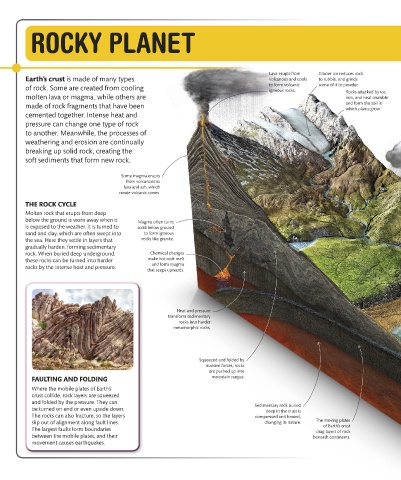
          Earth’s crust is made of many types                                                    volcanoes and cools    to rubble, and grinds
          of rock. Some are created from cooling                                                 to form volcanic    some of it to powder.
                                                                                                 igneous rocks.
                                                                                                                            Rocks attacked by ice,
          molten lava or magma, while others are                                                                            rain, and heat crumble
          made of rock fragments that have been                                                                             and form the soil in
                                                                                                                            which plants grow.
          cemented together. Intense heat and
          pressure can change one type of rock
          to another. Meanwhile, the processes of
          weathering and erosion are continually
          breaking up solid rock, creating the
          soft sediments that form new rock.

                                            Some magma erupts
                                              from volcanoes as
                                             lava and ash, which
                                           create volcanic cones.
          THE ROCK CYCLE

          Molten rock that erupts from deep
          below the ground is worn away when it    Magma often turns
          is exposed to the weather. It is turned to   solid below ground
          sand and clay, which are often swept into   to form igneous
          the sea. Here they settle in layers that   rocks like granite.
          gradually harden, forming sedimentary
          rock. When buried deep underground,          Chemical changes
          these rocks can be turned into harder       make hot rock melt
          rocks by the intense heat and pressure.      and form magma
                                                      that seeps upwards.


                                                                Heat and pressure
                                                             transform sedimentary
                                                                 rocks into harder
                                                               metamorphic rocks.


                                                                        Squeezed and folded by
                                                                          massive forces, rocks
                                                                            are pushed up into
            FAULTING AND FOLDING                                            mountain ranges.

            Where the mobile plates of Earth’s
            crust collide, rock layers are squeezed
            and folded by the pressure. They can
            be turned on end or even upside down.                                           Sedimentary rock buried
                                                                                                deep in the crust is
            The rocks can also fracture, so the layers                                      compressed and heated,
            slip out of alignment along fault lines.                                           changing its nature.  The moving plates
                                                                                                                    of Earth’s crust
            The largest faults form boundaries                                                                    drag layers of rock
            between the mobile plates, and their                                                                 beneath continents.
            movement causes earthquakes.


   US_032-033_Rocky_planet.indd   32                                                                                                 01/03/17   3:46 pm

