


Page 96 - Super Earth Encyclopedia
P. 96
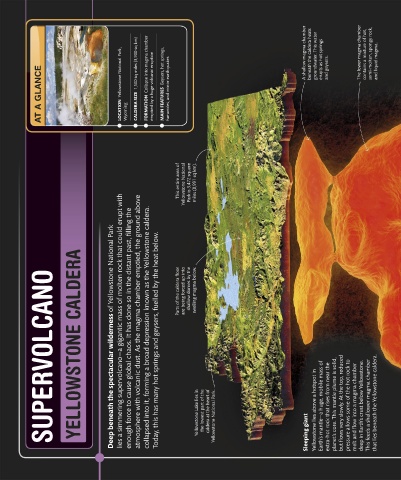
AT A GLANCE                 LOCATION  Yellowstone National Park,    CALDERA SIZE  1,500 sq miles (3,900 sq km) FORMATION  Collapse into magma chamber  emptied by a huge volcanic eruption MAIN FEATURES  Geysers, hot springs,   fumaroles, and minor earthquakes  A shallow magma chamber  beneath the caldera heats   groundwater. This water   erupts as hot springs    and geysers.  The lower magma chamber  contains a mixture of hot,  semi-molten, spongy rock,   and liquid magma.


                                             •   Wyoming  •   •   •


                                                                 This entire area of   Yellowstone National   Park is 3,472 square   miles (8,991 sq km).


                                            lies a simmering supervolcano—a gigantic mass of molten rock that could erupt with
                                                   atmosphere with volcanic dust. As the magma chamber emptied, the ground above
                                                      collapsed into it, forming a broad depression known as the Yellowstone caldera.
                                                enough force to cause global chaos. It has done so in the distant past, filling the

                                         Deep beneath the spectacular wilderness of Yellowstone National Park

                                                         Today, this has many hot springs and geysers, fuelled by the heat below.

                              YELLOWSTONE CALDERA


                                                                 Parts of the caldera floor   are being forced up into   shallow domes by the   swelling magma below.
                    SUPERVOLCANO


                                                                        Yellowstone Lake lies in   the lowest part of the   caldera at the heart of  Yellowstone National Park.  Sleeping giant Yellowstone lies above a hotspot in   Earth’s mantle—a huge, mobile mass of  extra-hot rock that rises from near the  planet’s core. This mantle plume is solid,   but flows very slowly. At the top, reduced  pressure allows some of the hot rock to  melt and flow into a magma chamber   deep in Earth’s crust below Yellowstone.   This feeds a shallower magma chamber  that lies


   US_094-095_Yellowstone.indd   94                                                                                                  01/03/17   1:38 pm

