


Page 24 - DINOSOUR ATLAS
P. 24
dinosaur atlas
         Reptiles in the Sea


         The marine repTiles of The mesozoic era were only distantly related to the
         dinosaurs, but they lived at the same time and probably preyed on them if they
         got the chance. Many were giants with formidable jaws, and some were as highly
         adapted to life in the water as modern whales and dolphins. Since they lived in
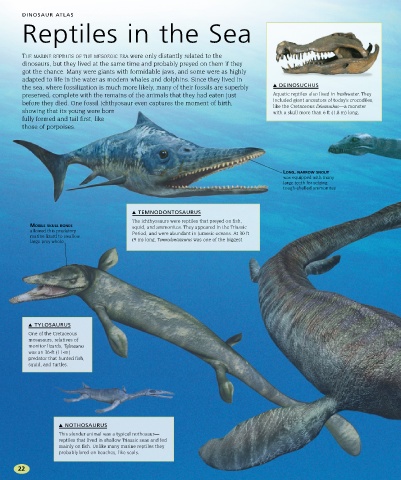
         the sea, where fossilization is much more likely, many of their fossils are superbly     u deinosuchus
         preserved, complete with the remains of the animals that they had eaten just             Aquatic reptiles also lived in freshwater. They
         before they died. One fossil ichthyosaur even captures the moment of birth,              included giant ancestors of today’s crocodiles,
                                                                                                  like the Cretaceous Deinosuchus—a monster
         showing that its young were born                                                         with a skull more than 6 ft (1.8 m) long.
         fully formed and tail first, like
         those of porpoises.


                                                                                                      Long, narrow snout
                                                                                                      was equipped with many
                                                                                                      large teeth for seizing
                                                                                                      tough-shelled ammonites


                                                u temnodontosaurus
                                                The ichthyosaurs were reptiles that preyed on fish,
            MobiLe skuLL bones                  squid, and ammonites. They appeared in the Triassic
            allowed this predatory              Period, and were abundant in Jurassic oceans. At 30 ft
            marine lizard to swallow
            large prey whole                    (9 m) long, Temnodontosaurus was one of the biggest.


           u tylosaurus
           One of the Cretaceous
           mosasaurs, relatives of
           monitor lizards, Tylosaurus
           was an 36-ft (11-m)
           predator that hunted fish,
           squid, and turtles.


                      u nothosaurus
                      This slender animal was a typical nothosaur—
                      reptiles that lived in shallow Triassic seas and fed
                      mainly on fish. Unlike many marine reptiles they
                      probably bred on beaches, like seals.

       22

