


Page 266 - Euclid's Elements of Geometry
P. 266
ST	EW      jþ.

                                    ieþ                         number can measure A except (one of) B, C, D. (Which


                                                                                            ELEMENTS BOOK 9


                                                                is) the very thing it was required to show.

                                      .
                                                                                 Proposition 15
               ᾿Εὰν τρεῖς ἀριθμοὶ ἑξῆς ἀνάλογον ὦσιν ἐλάχιστοι τῶν  If three continuously proportional numbers are the
            τὸν αὐτὸν λόγον ἐχόντων αὐτοῖς, δύο ὁποιοιοῦν συν-  least of those (numbers) having the same ratio as them
            τεθέντες πρὸς τὸν λοιπὸν πρῶτοί εἰσιν.              then two (of them) added together in any way are prime
                                                                to the remaining (one).
                                         ∆      Ε        Ζ                                  D      E         F
               Α                                                  A

               Β                                                  B

               Γ                                                  C
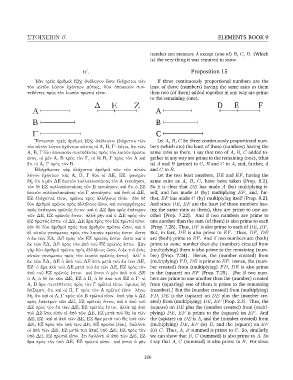
               ῎Εστωσαν τρεῖς ἀριθμοὶ ἑξῆς ἀνάλογον ἐλάχιστοι τῶν  Let A, B, C be three continuously proportional num-
            τὸν αὐτὸν λόγον ἐχόντων αὐτοῖς οἱ Α, Β, Γ· λέγω, ὅτι τῶν  bers (which are) the least of those (numbers) having the
            Α, Β, Γ δύο ὁποιοιοῦν συντεθέντες πρὸς τὸν λοιπὸν πρῶτοι  same ratio as them. I say that two of A, B, C added to-
            εἰσιν, οἱ μὲν Α, Β πρὸς τὸν Γ, οἱ δὲ Β, Γ πρὸς τὸν Α καὶ gether in any way are prime to the remaining (one), (that
            ἔτι οἱ Α, Γ πρὸς τὸν Β.                             is) A and B (prime) to C, B and C to A, and, further, A
               Εἰλήφθωσαν γὰρ ἐλάχιστοι ἀριθμοὶ τῶν τὸν αὐτὸν and C to B.
            λόγον ἐχόντων τοῖς Α, Β, Γ δύο οἱ ΔΕ, ΕΖ. φανερὸν      Let the two least numbers, DE and EF, having the
            δή, ὅτι ὁ μὲν ΔΕ ἑαυτὸν πολλαπλασιάσας τὸν Α πεποίηκεν, same ratio as A, B, C, have been taken [Prop. 8.2].
            τὸν δὲ ΕΖ πολλαπλασιάσας τὸν Β πεποίηκεν, καὶ ἔτι ὁ ΕΖ  So it is clear that DE has made A (by) multiplying it-
            ἑαυτὸν πολλαπλασιάσας τὸν Γ πεποίηκεν. καὶ ἐπεὶ οἱ ΔΕ,  self, and has made B (by) multiplying EF, and, fur-
            ΕΖ ἐλάχιστοί εἰσιν, πρῶτοι πρὸς ἀλλήλους εἰσίν. ἐὰν δὲ  ther, EF has made C (by) multiplying itself [Prop. 8.2].
            δύο ἀριθμοὶ πρῶτοι πρὸς ἀλλήλους ὦσιν, καὶ συναμφότερος  And since DE, EF are the least (of those numbers hav-
            πρὸς ἑκάτερον πρῶτός ἐστιν· καὶ ὁ ΔΖ ἄρα πρὸς ἑκάτερον ing the same ratio as them), they are prime to one an-
            τῶν ΔΕ, ΕΖ πρῶτός ἐστιν. ἀλλὰ μὴν καὶ ὁ ΔΕ πρὸς τὸν other [Prop. 7.22]. And if two numbers are prime to
            ΕΖ πρῶτός ἐστιν· οἱ ΔΖ, ΔΕ ἄρα πρὸς τὸν ΕΖ πρῶτοί εἰσιν. one another then the sum (of them) is also prime to each
            ἐὰν δὲ δύο ἀριθμοὶ πρός τινα ἀριθμὸν πρῶτοι ὦσιν, καὶ ὁ  [Prop. 7.28]. Thus, DF is also prime to each of DE, EF.
            ἐξ αὐτῶν γενόμενος πρὸς τὸν λοιπὸν πρῶτός ἐστιν· ὥστε  But, in fact, DE is also prime to EF. Thus, DF, DE
            ὁ ἐκ τῶν ΖΔ, ΔΕ πρὸς τὸν ΕΖ πρῶτός ἐστιν· ὥστε καὶ ὁ  are (both) prime to EF. And if two numbers are (both)
            ἐκ τῶν ΖΔ, ΔΕ πρὸς τὸν ἀπὸ τοῦ ΕΖ πρῶτός ἐστιν. [ἐὰν prime to some number then the (number) created from
            γὰρ δύο ἀριθμοὶ πρῶτοι πρὸς ἀλλήλους ὦσιν, ὁ ἐκ τοῦ ἑνὸς  (multiplying) them is also prime to the remaining (num-
            αὐτῶν γενόμενος πρὸς τὸν λοιπὸν πρῶτός ἐστιν]. ἀλλ᾿ ὁ  ber) [Prop. 7.24]. Hence, the (number created) from
            ἐκ τῶν ΖΔ, ΔΕ ὁ ἀπὸ τοῦ ΔΕ ἐστι μετὰ τοῦ ἐκ τῶν ΔΕ,  (multiplying) FD, DE is prime to EF. Hence, the (num-
            ΕΖ· ὁ ἄρα ἀπὸ τοῦ ΔΕ μετὰ τοῦ ἐκ τῶν ΔΕ, ΕΖ πρὸς τὸν ber created) from (multiplying) FD, DE is also prime
            ἀπὸ τοῦ ΕΖ πρῶτός ἐστιν. καί ἐστιν ὁ μὲν ἀπὸ τοῦ ΔΕ  to the (square) on EF [Prop. 7.25]. [For if two num-
            ὁ Α, ὁ δὲ ἐκ τῶν ΔΕ, ΕΖ ὁ Β, ὁ δὲ ἀπὸ τοῦ ΕΖ ὁ Γ· οἱ  bers are prime to one another then the (number) created
            Α, Β ἄρα συντεθέντες πρὸς τὸν Γ πρῶτοί εἰσιν. ὁμοίως δὴ  from (squaring) one of them is prime to the remaining
            δείξομεν, ὅτι καὶ οἱ Β, Γ πρὸς τὸν Α πρῶτοί εἰσιν. λέγω (number).] But the (number created) from (multiplying)
            δή, ὅτι καὶ οἱ Α, Γ πρὸς τὸν Β πρῶτοί εἰσιν. ἐπεὶ γὰρ ὁ ΔΖ  FD, DE is the (square) on DE plus the (number cre-
            πρὸς ἑκάτερον τῶν ΔΕ, ΕΖ πρῶτός ἐστιν, καὶ ὁ ἀπὸ τοῦ ated) from (multiplying) DE, EF [Prop. 2.3]. Thus, the
            ΔΖ πρὸς τὸν ἐκ τῶν ΔΕ, ΕΖ πρῶτός ἐστιν. ἀλλὰ τῷ ἀπὸ (square) on DE plus the (number created) from (multi-
            τοῦ ΔΖ ἴσοι εἰσὶν οἱ ἀπὸ τῶν ΔΕ, ΕΖ μετὰ τοῦ δὶς ἐκ τῶν  plying) DE, EF is prime to the (square) on EF. And
            ΔΕ, ΕΖ· καὶ οἱ ἀπὸ τῶν ΔΕ, ΕΖ ἄρα μετὰ τοῦ δὶς ὑπὸ τῶν  the (square) on DE is A, and the (number created) from
            ΔΕ, ΕΖ πρὸς τὸν ὑπὸ τῶν ΔΕ, ΕΖ πρῶτοί [εἰσι]. διελόντι (multiplying) DE, EF (is) B, and the (square) on EF
            οἱ ἀπὸ τῶν ΔΕ, ΕΖ μετὰ τοῦ ἅπαξ ὑπὸ ΔΕ, ΕΖ πρὸς τὸν (is) C. Thus, A, B summed is prime to C. So, similarly,
            ὑπὸ ΔΕ, ΕΖ πρῶτοί εἰσιν. ἔτι διελόντι οἱ ἀπὸ τῶν ΔΕ, ΕΖ  we can show that B, C (summed) is also prime to A. So
            ἄρα πρὸς τὸν ὑπὸ ΔΕ, ΕΖ πρῶτοί εἰσιν. καί ἐστιν ὁ μὲν I say that A, C (summed) is also prime to B. For since


                                                             266

