


Page 269 - Euclid's Elements of Geometry
P. 269
ST	EW      jþ.


                                                                                            ELEMENTS BOOK 9


            ἐκ τῶν Α, Δ ἴσος ἐστὶ τῷ ἀπὸ τοῦ Β. ἔστιν ἄρα ὡς ὁ Α ing D. But, in fact, B has also made C (by) multiplying
            πρὸς τὸν Β, ὁ Β πρὸς τὸν Δ· τοῖς Α, Β ἄρα τρίτος ἀριθμὸς itself. Thus, the (number created) from (multiplying) A,
            ἀνάλογον προσηύρηται ὁ Δ.                           D is equal to the (square) on B. Thus, as A is to B, (so)
               ᾿Αλλὰ δὴ μὴ μετρείτω ὁ Α τὸν Γ· λέγω, ὅτι τοῖς Α, Β  B (is) to D [Prop. 7.19]. Thus, a third number has been
            ἀδύνατόν ἐστι τρίτον ἀνάλογον προσευρεῖν ἀριθμόν. εἰ γὰρ found proportional to A, B, (namely) D.
            δυνατόν, προσηυρήσθω ὁ Δ. ὁ ἄρα ἐκ τῶν Α, Δ ἴσος ἐστὶ  And so let A not measure C. I say that it is impossi-
            τῷ ἀπὸ τοῦ Β. ὁ δὲ ἀπὸ τοῦ Β ἐστιν ὁ Γ· ὁ ἄρα ἐκ τῶν Α, ble to find a third number proportional to A, B. For, if
            Δ ἴσος ἐστὶ τῷ Γ. ὥστε ὁ Α τὸν Δ πολλαπλασιάσας τὸν possible, let it have been found, (and let it be) D. Thus,
            Γ πεποίηκεν· ὁ Α ἄρα τὸν Γ μετρεῖ κατὰ τὸν Δ. ἀλλα μὴν the (number created) from (multiplying) A, D is equal to
                                    ijþ                         fact, also assumed (to be) not measuring (C). The very
            ὑπόκειται καὶ μὴ μετρῶν· ὅπερ ἄτοπον. οὐκ ἄρα δυνατόν the (square) on B [Prop. 7.19]. And the (square) on B
            ἐστι τοῖς Α, Β τρίτον ἀνάλογον προσευρεῖν ἀριθμὸν, ὅταν is C. Thus, the (number created) from (multiplying) A,
            ὁ Α τὸν Γ μὴ μετρῇ· ὅπερ ἔδει δεῖξαι.               D is equal to C. Hence, A has made C (by) multiplying
                                                                D. Thus, A measures C according to D. But (A) was, in
                                                                thing (is) absurd. Thus, it is not possible to find a third
                                                                number proportional to A, B when A does not measure
                                                                C. (Which is) the very thing it was required to show.
                                      .
                                                                                                †
                                                                                Proposition 19
               Τριῶν ἀριθμῶν δοθέντων ἐπισκέψασθαι, πότε δυνατόν   For three given numbers, to investigate when it is pos-
            ἐστιν αὐτοῖς τέταρτον ἀνάλογον προσευρεῖν.          sible to find a fourth (number) proportional to them.
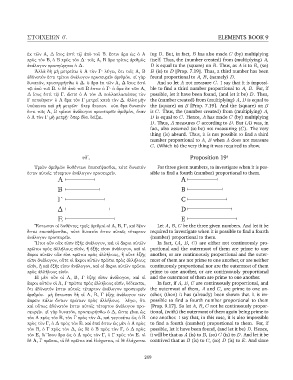
                         Α                                                   A

                         Β                                                   B
                         Γ                                                   C

                         ∆                                                   D
                         Ε                                                   E
               ῎Εστωσαν οἱ δοθέντες τρεῖς ἀριθμοὶ οἱ Α, Β, Γ, καὶ δέον  Let A, B, C be the three given numbers. And let it be
            ἔστω επισκέψασθαι, πότε δυνατόν ἐστιν αὐτοῖς τέταρτον required to investigate when it is possible to find a fourth
            ἀνάλογον προσευρεῖν.                                (number) proportional to them.
               ῎Ητοι οὖν οὔκ εἰσιν ἑξῆς ἀνάλογον, καὶ οἱ ἄκροι αὐτῶν  In fact, (A, B, C) are either not continuously pro-
            πρῶτοι πρὸς ἀλλήλους εἰσίν, ἢ ἑξῆς εἰσιν ἀνάλογον, καὶ οἱ  portional and the outermost of them are prime to one
            ἄκροι αὐτῶν οὔκ εἰσι πρῶτοι πρὸς ἀλλήλους, ἢ οὕτε ἑξῆς another, or are continuously proportional and the outer-
            εἰσιν ἀνάλογον, οὔτε οἱ ἄκροι αὐτῶν πρῶτοι πρὸς ἀλλήλους most of them are not prime to one another, or are neither
            εἰσίν, ἢ καὶ ἑξῆς εἰσιν ἀνάλογον, καὶ οἱ ἄκροι αὐτῶν πρῶτοι  continuously proportional nor are the outermost of them
            πρὸς ἀλλήλους εἰσίν.                                prime to one another, or are continuously proportional
               Εἰ μὲν οὖν οἱ Α, Β, Γ ἑξῆς εἰσιν ἀνάλογον, καὶ οἱ  and the outermost of them are prime to one another.
            ἄκροι αὐτῶν οἱ Α, Γ πρῶτοι πρὸς ἀλλήλους εἰσίν, δέδεικται,  In fact, if A, B, C are continuously proportional, and
            ὅτι ἀδύνατόν ἐστιν αὐτοῖς τέταρτον ἀνάλογον προσευρεῖν the outermost of them, A and C, are prime to one an-
            ἀριθμόν. μὴ ἔστωσαν δὴ οἱ Α, Β, Γ ἑξῆς ἀνάλογον τῶν  other, (then) it has (already) been shown that it is im-
            ἀκρῶν πάλιν ὄντων πρώτων πρὸς ἀλλήλους.  λέγω, ὅτι  possible to find a fourth number proportional to them
            καὶ οὕτως ἀδύνατόν ἐστιν αὐτοῖς τέταρτον ἀνάλογον προ- [Prop. 9.17]. So let A, B, C not be continuously propor-
            σευρεῖν. εἰ γὰρ δυνατόν, προσευρήσθω ὁ Δ, ὥστε εἶναι ὡς  tional, (with) the outermost of them again being prime to
            τὸν Α πρὸς τὸν Β, τὸν Γ πρὸς τὸν Δ, καὶ γεγονέτω ὡς ὁ Β  one another. I say that, in this case, it is also impossible
            πρὸς τὸν Γ, ὁ Δ πρὸς τὸν Ε. καὶ ἐπεί ἐστιν ὡς μὲν ὁ Α πρὸς  to find a fourth (number) proportional to them. For, if
            τὸν Β, ὁ Γ πρὸς τὸν Δ, ὡς δὲ ὁ Β πρὸς τὸν Γ, ὁ Δ πρὸς  possible, let it have been found, (and let it be) D. Hence,
            τὸν Ε, δι᾿ ἴσου ἄρα ὡς ὁ Α πρὸς τὸν Γ, ὁ Γ πρὸς τὸν Ε. οἱ  it will be that as A (is) to B, (so) C (is) to D. And let it be
            δὲ Α, Γ πρῶτοι, οἱ δὲ πρῶτοι καὶ ἐλάχιστοι, οἱ δὲ ἐλάχιστοι contrived that as B (is) to C, (so) D (is) to E. And since


                                                             269

