


Page 267 - Euclid's Elements of Geometry
P. 267
ST	EW      jþ.


                                                                                            ELEMENTS BOOK 9


            ἀπὸ τοῦ ΔΕ ὁ Α, ὁ δὲ ὑπὸ τῶν ΔΕ, ΕΖ ὁ Β, ὁ δὲ ἀπὸ τοῦ DF is prime to each of DE, EF then the (square) on DF
            ΕΖ ὁ Γ. οἱ Α, Γ ἄρα συντεθέντες πρὸς τὸν Β πρῶτοί εἰσιν· is also prime to the (number created) from (multiplying)
            ὅπερ ἔδει δεῖξαι.                                   DE, EF [Prop. 7.25]. But, the (sum of the squares) on
                                                                DE, EF plus twice the (number created) from (multiply-
                                                                ing) DE, EF is equal to the (square) on DF [Prop. 2.4].
                                                                And thus the (sum of the squares) on DE, EF plus twice
                                                                the (rectangle contained) by DE, EF [is] prime to the
                                                                (rectangle contained) by DE, EF. By separation, the
                                                                (sum of the squares) on DE, EF plus once the (rect-
                                                                angle contained) by DE, EF is prime to the (rectangle
                                    iþ                         contained) by DE, EF. And the (square) on DE is A,
                                                                                     †
                                                                contained) by DE, EF. Again, by separation, the (sum
                                                                of the squares) on DE, EF is prime to the (rectangle
                                                                and the (rectangle contained) by DE, EF (is) B, and
                                                                the (square) on EF (is) C. Thus, A, C summed is prime
                                                                to B. (Which is) the very thing it was required to show.

                                  2
                              2
                                                             2
                                                         2
            †  Since if α β measures α + β + 2 α β then it also measures α + β + α β, and vice versa.
                                                                                 Proposition 16
                                      .
               ᾿Εὰν δύο ἀριθμοὶ πρῶτοι πρὸς ἀλλήλους ὦσιν, οὐκ ἔσται  If two numbers are prime to one another then as the
            ὡς ὁ πρῶτος πρὸς τὸν δεύτερον, οὕτως ὁ δεύτερος πρὸς  first is to the second, so the second (will) not (be) to some
            ἄλλον τινά.                                         other (number).
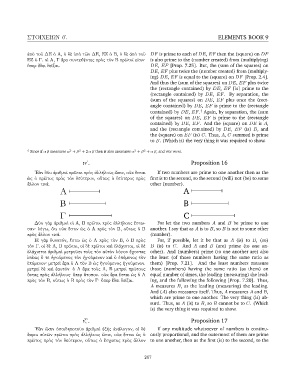
                          Α                                                   A

                          Β                                                   B

                          Γ                                                   C

               Δύο γὰρ ἀριθμοὶ οἱ Α, Β πρῶτοι πρὸς ἀλλήλους ἔστω-  For let the two numbers A and B be prime to one
            σαν· λέγω, ὅτι οὐκ ἔστιν ὡς ὁ Α πρὸς τὸν Β, οὕτως ὁ Β  another. I say that as A is to B, so B is not to some other
            πρὸς ἄλλον τινά.                                    (number).
               Εἰ γὰρ δυνατόν, ἔστω ὡς ὁ Α πρὸς τὸν Β, ὁ Β πρὸς    For, if possible, let it be that as A (is) to B, (so)
            τὸν Γ. οἱ δὲ Α, Β πρῶτοι, οἱ δὲ πρῶτοι καὶ ἐλάχιστοι, οἱ δὲ  B (is) to C.  And A and B (are) prime (to one an-
            ἐλάχιστοι ἀριθμοὶ μετροῦσι τοὺς τὸν αὐτὸν λόγον ἔχοντας other). And (numbers) prime (to one another are) also
            ἰσάκις ὅ τε ἡγούμενος τὸν ἡγούμενον καὶ ὁ ἑπόμενος τὸν the least (of those numbers having the same ratio as
            ἑπόμενον· μετρεῖ ἄρα ὁ Α τὸν Β ὡς ἡγούμενος ἡγούμενον. them) [Prop. 7.21].  And the least numbers measure
                                    izþ                         And (A) also measures itself. Thus, A measures A and B,
            μετρεῖ δὲ καὶ ἑαυτόν· ὁ Α ἄρα τοὺς Α, Β μετρεῖ πρώτους those (numbers) having the same ratio (as them) an
            ὄντας πρὸς ἀλλήλους· ὅπερ ἄτοπον. οὐκ ἄρα ἔσται ὡς ὁ Α equal number of times, the leading (measuring) the lead-
            πρὸς τὸν Β, οὕτως ὁ Β πρὸς τὸν Γ· ὅπερ ἔδει δεῖξαι.  ing, and the following the following [Prop. 7.20]. Thus,
                                                                A measures B, as the leading (measuring) the leading.

                                                                which are prime to one another. The very thing (is) ab-
                                                                surd. Thus, as A (is) to B, so B cannot be to C. (Which
                                                                is) the very thing it was required to show.

                                                                                 Proposition 17
                                      .
               ᾿Εὰν ὦσιν ὁσοιδηποτοῦν ἀριθμοὶ ἑξῆς ἀνάλογον, οἱ δὲ  If any multitude whatsoever of numbers is continu-
            ἄκροι αὐτῶν πρῶτοι πρὸς ἀλλήλους ὦσιν, οὐκ ἔσται ὡς ὁ  ously proportional, and the outermost of them are prime
            πρῶτος πρὸς τὸν δεύτερον, οὕτως ὁ ἔσχατος πρὸς ἄλλον to one another, then as the first (is) to the second, so the


                                                             267

