


Page 292 - Euclid's Elements of Geometry
P. 292
ST	EW      iþ.                                                             ELEMENTS BOOK 10


                                    iaþ                         commensurable with the given straight-line A, have been
                                                                   Thus, two straight-lines, D and E, (which are) in-
                                                                found, the one, D, (incommensurable) in length only, the
                                                                other, E, (incommensurable) in square, and, clearly, also
                                                                in length. [(Which is) the very thing it was required to
                                                                show.]

            †  This whole proposition is regarded by Heiberg as an interpolation into the original text.

                                                                                 Proposition 11
                                      .
               ᾿Εὰν τέσσαρα μεγέθη ἀνάλογον ᾖ, τὸ δὲ πρῶτον τῷ     If four magnitudes are proportional, and the first is
            δευτέρῳ σύμμετρον ᾖ, καὶ τὸ τρίτον τῷ τετάρτῳ σύμμετρον commensurable with the second, then the third will also
            ἔσται· κἂν τὸ πρῶτον τῷ δευτέρῳ ἀσύμμετρον ᾖ, καὶ τὸ  be commensurable with the fourth. And if the first is in-
            τρίτον τῷ τετάρτῳ ἀσύμμετρον ἔσται.                 commensurable with the second, then the third will also
                                                                be incommensurable with the fourth.
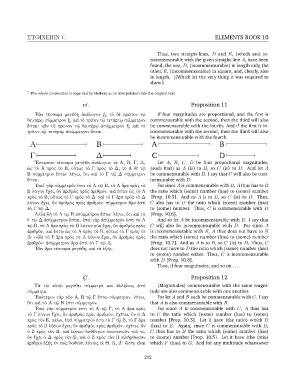
              Α                          Β                       A                           B

              Γ                          ∆                       C                           D
               ῎Εστωσαν τέσσαρα μεγέθη ἀνάλογον τὰ Α, Β, Γ, Δ,     Let A, B, C, D be four proportional magnitudes,
            ὡς τὸ Α πρὸς τὸ Β, οὕτως τὸ Γ πρὸς τὸ Δ, τὸ Α δὲ τῷ (such that) as A (is) to B, so C (is) to D. And let A
            Β σύμμετρον ἔστω· λέγω, ὅτι καὶ τὸ Γ τῷ Δ σύμμετρον be commensurable with B. I say that C will also be com-
            ἔσται.                                              mensurable with D.
               ᾿Επεὶ γὰρ σύμμετρόν ἐστι τὸ Α τῷ Β, τὸ Α ἄρα πρὸς τὸ  For since A is commensurable with B, A thus has to B
            Β λόγον ἔχει, ὃν ἀριθμὸς πρὸς ἀριθμόν. καί ἐστιν ὡς τὸ Α the ratio which (some) number (has) to (some) number
            πρὸς τὸ Β, οὕτως τὸ Γ πρὸς τὸ Δ· καὶ τὸ Γ ἄρα πρὸς τὸ Δ [Prop. 10.5]. And as A is to B, so C (is) to D. Thus,
            λόγον ἔχει, ὃν ἀριθμὸς πρὸς ἀριθμόν· σύμμετρον ἄρα ἐστὶ  C also has to D the ratio which (some) number (has)
            τὸ Γ τῷ Δ.                                          to (some) number. Thus, C is commensurable with D
               ᾿Αλλὰ δὴ τὸ Α τῷ Β ἀσύμμετρον ἔστω· λέγω, ὅτι καὶ τὸ  [Prop. 10.6].
            Γ τῷ Δ ἀσύμμετρον ἔσται. ἐπεὶ γὰρ ἀσύμμετρόν ἐστι τὸ Α  And so let A be incommensurable with B. I say that
                                    ibþ                         to (some) number either. Thus, C is incommensurable
            τῷ Β, τὸ Α ἄρα πρὸς τὸ Β λόγον οὐκ ἔχει, ὃν ἀριθμὸς πρὸς  C will also be incommensurable with D. For since A
            ἀριθμόν. καί ἐστιν ὡς τὸ Α πρὸς τὸ Β, οὕτως τὸ Γ πρὸς τὸ  is incommensurable with B, A thus does not have to B
            Δ· οὐδὲ τὸ Γ ἄρα πρὸς τὸ Δ λόγον ἔχει, ὃν ἀριθμὸς πρὸς  the ratio which (some) number (has) to (some) number
            ἀριθμόν· ἀσύμμετρον ἄρα ἐστὶ τὸ Γ τῷ Δ.             [Prop. 10.7]. And as A is to B, so C (is) to D. Thus, C
               ᾿Εὰν ἄρα τέσσαρα μεγέθη, καὶ τὰ ἑξῆς.            does not have to D the ratio which (some) number (has)

                                                                with D [Prop. 10.8].
                                                                   Thus, if four magnitudes, and so on . . . .

                                      .
                                                                                 Proposition 12
               Τὰ τῷ αὐτῷ μεγέθει σύμμετρα καὶ ἀλλήλοις ἐστὶ       (Magnitudes) commensurable with the same magni-
            σύμμετρα.                                           tude are also commensurable with one another.
               ῾Εκάτερον γὰρ τῶν Α, Β τῷ Γ ἔστω σύμμετρον. λέγω,   For let A and B each be commensurable with C. I say
            ὅτι καὶ τὸ Α τῷ Β ἐστι σύμμετρον.                   that A is also commensurable with B.
               ᾿Επεὶ γὰρ σύμμετρόν ἐστι τὸ Α τῷ Γ, τὸ Α ἄρα πρὸς   For since A is commensurable with C, A thus has
            τὸ Γ λόγον ἔχει, ὃν ἀριθμὸς πρὸς ἀριθμόν. ἐχέτω, ὃν ὁ Δ to C the ratio which (some) number (has) to (some)
            πρὸς τὸν Ε. πάλιν, ἐπεὶ σύμμετρόν ἐστι τὸ Γ τῷ Β, τὸ Γ ἄρα number [Prop. 10.5]. Let it have (the ratio) which D
            πρὸς τὸ Β λόγον ἔχει, ὃν ἀριθμὸς πρὸς ἀριθμόν. ἐχέτω, ὃν (has) to E. Again, since C is commensurable with B,
            ὁ Ζ πρὸς τὸν Η. καὶ λόγων δοθέντων ὁποσωνοῦν τοῦ τε, C thus has to B the ratio which (some) number (has)
            ὃν ἔχει ὁ Δ πρὸς τὸν Ε, καὶ ὁ Ζ πρὸς τὸν Η εἰλήφθωσαν to (some) number [Prop. 10.5]. Let it have (the ratio)
            ἀριθμοὶ ἑξῆς ἐν τοῖς δοθεῖσι λόγοις οἱ Θ, Κ, Λ· ὥστε εἶναι which F (has) to G. And for any multitude whatsoever

                                                             292

