


Page 298 - Euclid's Elements of Geometry
P. 298
ST	EW      iþ.


                                                                                           ELEMENTS BOOK 10


            ΒΓ, τῷ δὲ τετράρτῳ μέρει τοῦ ἀπὸ ἐλάσσονος τῆς Α, greater, and a (rectangle) equal to the fourth (part) of the
            τουτέστι τῷ ἀπὸ τῆς ἡμισείας τῆς Α, ἴσον παρὰ τὴν ΒΓ  (square) on the lesser, falling short by a square figure, is
            παραβεβλήσθω ἐλλεῖπον εἴδει τετραγώνῳ, καὶ ἔστω τὸ ὑπὸ applied to the greater, then it divides it into (parts which
            τῶν ΒΔ, ΔΓ, σύμμετρος δὲ ἔστω ἡ ΒΔ τῇ ΔΓ μήκει· λέγω, are) commensurable in length.
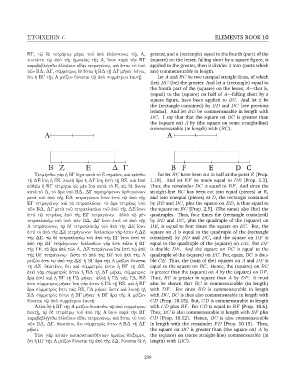
            ὃτι ἡ ΒΓ τῆς Α μεῖζον δύναται τῷ ἀπὸ συμμέτρου ἑαυτῇ.  Let A and BC be two unequal straight-lines, of which
                                                                (let) BC (be) the greater. And let a (rectangle) equal to
                                                                the fourth part of the (square) on the lesser, A—that is,
                                                                (equal) to the (square) on half of A—falling short by a
                                                                square figure, have been applied to BC. And let it be
                                                                the (rectangle contained) by BD and DC [see previous
                                                                lemma]. And let BD be commensurable in length with
                                                                DC. I say that that the square on BC is greater than
                                                                the (square on) A by (the square on some straight-line)
                                                                commensurable (in length) with (BC).
                    Α                                                  A


                     Β Ζ             Ε          ∆   Γ                    B F            E           D   C
               Τετμήσθω γὰρ ἡ ΒΓ δίχα κατὰ τὸ Ε σημεῖον, καὶ κείσθω  For let BC have been cut in half at the point E [Prop.
            τῇ ΔΕ ἴση ἡ ΕΖ. λοιπὴ ἄρα ἡ ΔΓ ἴση ἐστὶ τῇ ΒΖ. καὶ ἐπεὶ 1.10]. And let EF be made equal to DE [Prop. 1.3].
            εὐθεῖα ἡ ΒΓ τέτμηται εἰς μὲν ἴσα κατὰ τὸ Ε, εἰς δὲ ἄνισα Thus, the remainder DC is equal to BF. And since the
            κατὰ τὸ Δ, τὸ ἄρα ὑπὸ ΒΔ, ΔΓ περειχόμενον ὀρθογώνιον straight-line BC has been cut into equal (pieces) at E,
            μετὰ τοῦ ἀπὸ τῆς ΕΔ τετραγώνου ἴσον ἐστὶ τῷ ἀπὸ τῆς and into unequal (pieces) at D, the rectangle contained
            ΕΓ τετραγώνῳ· καὶ τὰ τετραπλάσια· τὸ ἄρα τετράκις ὑπὸ by BD and DC, plus the square on ED, is thus equal to
            τῶν ΒΔ, ΔΓ μετὰ τοῦ τετραπλασίου τοῦ ἀπὸ τῆς ΔΕ ἴσον the square on EC [Prop. 2.5]. (The same) also (for) the
            ἐστὶ τῷ τετράκις ἀπὸ τῆς ΕΓ τετραγώνῳ. ἀλλὰ τῷ μὲν quadruples. Thus, four times the (rectangle contained)
            τετραπλασίῳ τοῦ ὑπὸ τῶν ΒΔ, ΔΓ ἴσον ἐστὶ τὸ ἀπὸ τῆς by BD and DC, plus the quadruple of the (square) on
            Α τετράγωνον, τῷ δὲ τετραπλασίῳ τοῦ ἀπὸ τῆς ΔΕ ἴσον DE, is equal to four times the square on EC. But, the
            ἐστὶ τὸ ἀπὸ τῆς ΔΖ τετράγωνον· διπλασίων γάρ ἐστιν ἡ ΔΖ  square on A is equal to the quadruple of the (rectangle
            τῆς ΔΕ. τῷ δὲ τετραπλασίῳ τοῦ ἀπὸ τῆς ΕΓ ἴσον ἐστὶ τὸ  contained) by BD and DC, and the square on DF is
            ἀπὸ τῆς ΒΓ τετράγωνον· διπλασίων γάρ ἐστι πάλιν ἡ ΒΓ  equal to the quadruple of the (square) on DE. For DF
            τῆς ΓΕ. τὰ ἄρα ἀπὸ τῶν Α, ΔΖ τετράγωνα ἴσα ἐστὶ τῷ ἀπὸ is double DE. And the square on BC is equal to the
            τῆς ΒΓ τετράγωνῳ· ὥστε τὸ ἀπὸ τῆς ΒΓ τοῦ ἀπὸ τῆς Α quadruple of the (square) on EC. For, again, BC is dou-
            μεῖζόν ἐστι τῷ ἀπὸ τῆς ΔΖ· ἡ ΒΓ ἄρα τῆς Α μεῖζον δύναται ble CE. Thus, the (sum of the) squares on A and DF is
            τῇ ΔΖ. δεικτέον, ὅτι καὶ σύμμετρός ἐστιν ἡ ΒΓ τῇ ΔΖ. equal to the square on BC. Hence, the (square) on BC
            ἐπεὶ γὰρ σύμμετρός ἐστιν ἡ ΒΔ τῇ ΔΓ μήκει, σύμμετρος  is greater than the (square) on A by the (square) on DF.
            ἄρα ἐστὶ καὶ ἡ ΒΓ τῇ ΓΔ μήκει. ἀλλὰ ἡ ΓΔ ταῖς ΓΔ, ΒΖ  Thus, BC is greater in square than A by DF. It must
            ἐστι σύμμετρος μήκει· ἴση γάρ ἐστιν ἡ ΓΔ τῇ ΒΖ. καὶ ἡ ΒΓ  also be shown that BC is commensurable (in length)
            ἄρα σύμμετρός ἐστι ταῖς ΒΖ, ΓΔ μήκει· ὥστε καὶ λοιπῇ τῇ  with DF.  For since BD is commensurable in length
            ΖΔ σύμμετρός ἐστιν ἡ ΒΓ μήκει· ἡ ΒΓ ἄρα τῆς Α μεῖζον with DC, BC is thus also commensurable in length with
            δύναται τῷ ἀπὸ συμμέτρου ἑαυτῇ.                     CD [Prop. 10.15]. But, CD is commensurable in length
               ᾿Αλλὰ δὴ ἡ ΒΓ τῆς Α μεῖζον δυνάσθω τῷ ἀπὸ συμμέτρου with CD plus BF. For CD is equal to BF [Prop. 10.6].
            ἑαυτῇ, τῷ δὲ τετράτρῳ τοῦ ἀπὸ τῆς Α ἴσον παρὰ τὴν ΒΓ  Thus, BC is also commensurable in length with BF plus
            παραβεβλήσθω ἐλλεῖπον εἴδει τετραγώνῳ, καὶ ἔστω τὸ ὑπὸ CD [Prop. 10.12]. Hence, BC is also commensurable
            τῶν ΒΔ, ΔΓ. δεικτέον, ὅτι σύμμετρός ἐστιν ἡ ΒΔ τῇ ΔΓ  in length with the remainder FD [Prop. 10.15]. Thus,
            μήκει.                                              the square on BC is greater than (the square on) A by
               Τῶν γὰρ αὐτῶν κατασκευασθέντων ὁμοίως δείξομεν, the (square) on (some straight-line) commensurable (in
            ὅτι ἡ ΒΓ τῆς Α μεῖζον δύναται τῷ ἀπὸ τῆς ΖΔ. δύναται δὲ ἡ  length) with (BC).


                                                             298

