


Page 293 - Euclid's Elements of Geometry
P. 293
ST	EW      iþ.


                                                                                           ELEMENTS BOOK 10


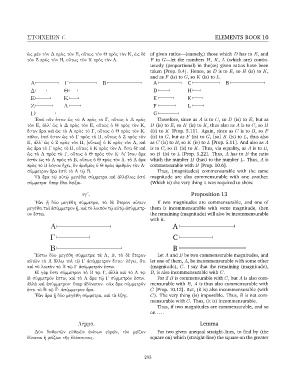
            ὡς μὲν τὸν Δ πρὸς τὸν Ε, οὕτως τὸν Θ πρὸς τὸν Κ, ὡς δὲ  of given ratios—(namely,) those which D has to E, and
            τὸν Ζ πρὸς τὸν Η, οὕτως τὸν Κ πρὸς τὸν Λ.           F to G—let the numbers H, K, L (which are) contin-
                                                                uously (proportional) in the(se) given ratios have been
                                                                taken [Prop. 8.4]. Hence, as D is to E, so H (is) to K,
                                                                and as F (is) to G, so K (is) to L.
              Α             Γ               Β                    A             C               B
              ∆             Θ                                    D             H
              Ε             Κ                                    E             K
              Ζ             Λ                                    F             L
              Η                                                  G
               ᾿Επεὶ οὖν ἐστιν ὡς τὸ Α πρὸς τὸ Γ, οὕτως ὁ Δ πρὸς   Therefore, since as A is to C, so D (is) to E, but as
            τὸν Ε, ἀλλ᾿ ὡς ὁ Δ πρὸς τὸν Ε, οὕτως ὁ Θ πρὸς τὸν Κ, D (is) to E, so H (is) to K, thus also as A is to C, so H
            ἔστιν ἄρα καὶ ὡς τὸ Α πρὸς τὸ Γ, οὕτως ὁ Θ πρὸς τὸν Κ. (is) to K [Prop. 5.11]. Again, since as C is to B, so F
            πάλιν, ἐπεί ἐστιν ὡς τὸ Γ πρὸς τὸ Β, οὕτως ὁ Ζ πρὸς τὸν (is) to G, but as F (is) to G, [so] K (is) to L, thus also
                                    igþ
            Η, ἀλλ᾿ ὡς ὁ Ζ πρὸς τὸν Η, [οὕτως] ὁ Κ πρὸς τὸν Λ, καὶ as C (is) to B, so K (is) to L [Prop. 5.11]. And also as A
            ὡς ἄρα τὸ Γ πρὸς τὸ Β, οὕτως ὁ Κ πρὸς τὸν Λ. ἔστι δὲ καὶ is to C, so H (is) to K. Thus, via equality, as A is to B,
            ὡς τὸ Α πρὸς τὸ Γ, οὕτως ὁ Θ πρὸς τὸν Κ· δι᾿ ἴσου ἄρα so H (is) to L [Prop. 5.22]. Thus, A has to B the ratio
            ἐστὶν ὡς τὸ Α πρὸς τὸ Β, οὕτως ὁ Θ πρὸς τὸν Λ. τὸ Α ἄρα which the number H (has) to the number L. Thus, A is
            πρὸς τὸ Β λόγον ἔχει, ὃν ἀριθμὸς ὁ Θ πρὸς ἀριθμὸν τὸν Λ· commensurable with B [Prop. 10.6].
            σύμμετρον ἄρα ἐστὶ τὸ Α τῷ Β.                          Thus, (magnitudes) commensurable with the same
               Τὰ ἄρα τῷ αὐτῷ μεγέθει σύμμετρα καὶ ἀλλήλοις ἐστὶ  magnitude are also commensurable with one another.
            σύμμετρα· ὅπερ ἔδει δεῖξαι.                         (Which is) the very thing it was required to show.

                                                                                 Proposition 13
                                      .
               ᾿Εὰν ᾖ δύο μεγέθη σύμμετρα, τὸ δὲ ἕτερον αὐτῶν      If two magnitudes are commensurable, and one of
            μεγέθει τινὶ ἀσύμμετρον ᾖ, καὶ τὸ λοιπὸν τῷ αὐτῷ ἀσύμμετρ- them is incommensurable with some magnitude, then
            ον ἔσται.                                           the remaining (magnitude) will also be incommensurable
                                                                with it.
                      Α                                                  A

                      Γ                                                  C

                      Β                                                  B
               ῎Εστω δύο μεγέθη σύμμετρα τὰ Α, Β, τὸ δὲ ἕτερον     Let A and B be two commensurable magnitudes, and
            αὐτῶν τὸ Α ἄλλῳ τινὶ τῷ Γ ἀσύμμετρον ἔστω· λέγω, ὅτι  let one of them, A, be incommensurable with some other
            καὶ τὸ λοιπὸν τὸ Β τῷ Γ ἀσύμμετρόν ἐστιν.           (magnitude), C. I say that the remaining (magnitude),
                                  ¨mma                         mensurable with C. Thus, (it is) incommensurable.
               Εἰ γάρ ἐστι σύμμετρον τὸ Β τῷ Γ, ἀλλὰ καὶ τὸ Α τῷ B, is also incommensurable with C.
            Β σύμμετρόν ἐστιν, καὶ τὸ Α ἄρα τῷ Γ σύμμετρόν ἐστιν.  For if B is commensurable with C, but A is also com-
            ἀλλὰ καὶ ἀσύμμετρον· ὅπερ ἀδύνατον. οὐκ ἄρα σύμμετρόν mensurable with B, A is thus also commensurable with
            ἐστι τὸ Β τῷ Γ· ἀσύμμετρον ἄρα.                     C [Prop. 10.12]. But, (it is) also incommensurable (with
               ᾿Εὰν ἄρα ᾖ δύο μεγέθη σύμμετρα, καὶ τὰ ἑξῆς.     C). The very thing (is) impossible. Thus, B is not com-

                                                                   Thus, if two magnitudes are commensurable, and so
                                                                on . . . .

                                        .
                                                                                     Lemma
               Δύο δοθεισῶν εὐθειῶν ἀνίσων εὑρεῖν, τίνι μεῖζον     For two given unequal straight-lines, to find by (the
            δύναται ἡ μείζων τῆς ἐλάσσονος.                     square on) which (straight-line) the square on the greater


                                                             293

