


Page 294 - Euclid's Elements of Geometry
P. 294
ST	EW      iþ.


                                                                                           ELEMENTS BOOK 10


                                                                (straight-line is) larger than (the square on) the lesser. †
                                                     Γ                                                   C
                              ∆                                                   D


                   Α                             Β                    A                              B
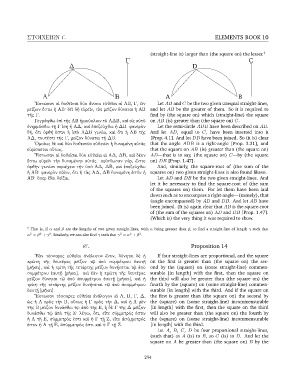
               ῎Εστωσαν αἱ δοθεῖσαι δύο ἄνισοι εὐθεῖαι αἱ ΑΒ, Γ, ὧν  Let AB and C be the two given unequal straight-lines,
            μείζων ἔστω ἡ ΑΒ· δεῖ δὴ εὑρεῖν, τίνι μεῖζον δύναται ἡ ΑΒ  and let AB be the greater of them. So it is required to
            τῆς Γ.                                              find by (the square on) which (straight-line) the square
               Γεγράφθω ἐπὶ τῆς ΑΒ ἡμικύκλιον τὸ ΑΔΒ, καὶ εἰς αὐτὸ on AB (is) greater than (the square on) C.
            ἐνηρμόσθω τῇ Γ ἴση ἡ ΑΔ, καὶ ἐπεζεύχθω ἡ ΔΒ. φανερὸν   Let the semi-circle ADB have been described on AB.
            δή, ὅτι ὀρθή ἐστιν ἡ ὑπὸ ΑΔΒ γωνία, καὶ ὅτι ἡ ΑΒ τῆς And let AD, equal to C, have been inserted into it
            ΑΔ, τουτέστι τῆς Γ, μεῖζον δύναται τῇ ΔΒ.           [Prop. 4.1]. And let DB have been joined. So (it is) clear
               ῾Ομοίως δὲ καὶ δύο δοθεισῶν εὐθειῶν ἡ δυναμένη αὐτὰς that the angle ADB is a right-angle [Prop. 3.31], and
            εὑρίσκεται οὕτως.                                   that the square on AB (is) greater than (the square on)
               ῎Εστωσαν αἱ δοθεῖσαι δύο εὐθεῖαι αἱ ΑΔ, ΔΒ, καὶ δέον AD—that is to say, (the square on) C—by (the square
            ἔστω εὑρεῖν τὴν δυναμένην αὐτάς. κείσθωσαν γάρ, ὥστε  on) DB [Prop. 1.47].
            ὀρθὴν γωνίαν περιέχειν τὴν ὑπὸ ΑΔ, ΔΒ, καὶ ἐπεζεύχθω   And, similarly, the square-root of (the sum of the
            ἡ ΑΒ· φανερὸν πάλιν, ὅτι ἡ τὰς ΑΔ, ΔΒ δυναμένη ἐστὶν ἡ  squares on) two given straight-lines is also found likeso.
            ΑΒ· ὅπερ ἔδει δεῖξαι.                                  Let AD and DB be the two given straight-lines. And
                                                                let it be necessary to find the square-root of (the sum
                                                                of the squares on) them. For let them have been laid
                                    idþ                         been joined. (It is) again clear that AB is the square-root
                                                                down such as to encompass a right-angle—(namely), that
                                                                (angle encompassed) by AD and DB. And let AB have

                                                                of (the sum of the squares on) AD and DB [Prop. 1.47].
                                                                (Which is) the very thing it was required to show.

            †  That is, if α and β are the lengths of two given straight-lines, with α being greater than β, to find a straight-line of length γ such that
                     2
                                                           2
                                                       2
                                                   2
             2
                  2
            α = β + γ . Similarly, we can also find γ such that γ = α + β .
                                                                                 Proposition 14
                                      .
               ᾿Εὰν τέσσαρες εὐθεῖαι ἀνάλογον ὦσιν, δύνηται δὲ ἡ   If four straight-lines are proportional, and the square
            πρώτη τῆς δευτέρας μεῖζον τῷ ἀπὸ συμμέτρου ἑαυτῇ on the first is greater than (the square on) the sec-
            [μήκει], καὶ ἡ τρίτη τῆς τετάρτης μεῖζον δυνήσεται τῷ ἀπὸ ond by the (square) on (some straight-line) commen-
            συμμέτρου ἑαυτῇ [μήκει]. καὶ ἐὰν ἡ πρώτη τῆς δευτέρας surable [in length] with the first, then the square on
            μεῖζον δύνηται τῷ ἀπὸ ἀσυμμέτρου ἑαυτῇ [μήκει], καὶ ἡ  the third will also be greater than (the square on) the
            τρίτη τῆς τετάρτης μεῖζον δυνήσεται τῷ ἀπὸ ἀσυμμέτρου fourth by the (square) on (some straight-line) commen-
            ἑαυτῇ [μήκει].                                      surable [in length] with the third. And if the square on
               ῎Εστωσαν τέσσαρες εὐθεῖαι ἀνάλογον αἱ Α, Β, Γ, Δ, the first is greater than (the square on) the second by
            ὡς ἡ Α πρὸς τὴν Β, οὕτως ἡ Γ πρὸς τὴν Δ, καὶ ἡ Α μὲν the (square) on (some straight-line) incommensurable
            τῆς Β μεῖζον δυνάσθω τῷ ἀπὸ τῆς Ε, ἡ δὲ Γ τῆς Δ μεῖζον [in length] with the first, then the square on the third
            δυνάσθω τῷ ἀπὸ τῆς Ζ· λέγω, ὅτι, εἴτε σύμμετρός ἐστιν will also be greater than (the square on) the fourth by
            ἡ Α τῇ Ε, σύμμετρός ἐστι καὶ ἡ Γ τῇ Ζ, εἴτε ἀσύμμετρός the (square) on (some straight-line) incommensurable
            ἐστιν ἡ Α τῇ Ε, ἀσύμμετρός ἐστι καὶ ὁ Γ τῇ Ζ.       [in length] with the third.
                                                                   Let A, B, C, D be four proportional straight-lines,
                                                                (such that) as A (is) to B, so C (is) to D. And let the
                                                                square on A be greater than (the square on) B by the


                                                             294

