


Page 297 - Euclid's Elements of Geometry
P. 297
ST	EW      iþ.


                                                                                           ELEMENTS BOOK 10


            ΓΑ, ΑΒ· ὑπέκειτο δὲ καὶ ἀσύμμετρα· ὅπερ ἐστὶν ἀδύνατον. AB. I say that AB and BC are also incommensurable.
            οὐκ ἄρα τὰ ΑΒ, ΒΓ μετρήσει τι μέγεθος· ἀσύμμετρα ἄρα For if they are commensurable then some magnitude will
            ἐστὶ τὰ ΑΒ, ΒΓ.                                     measure them. Let it (so) measure (them), and let it be
               ᾿Εὰν ἄρα δύο μεγέθη, καὶ τὰ ἑξῆς.                D. Therefore, since D measures (both) AB and BC, it
                                  ¨mma                         CA and AB are commensurable [Def. 10.1]. But they
                                                                will thus also measure the whole AC. And it also mea-
                                                                sures AB. Thus, D measures (both) CA and AB. Thus,

                                                                were also assumed (to be) incommensurable. The very
                                                                thing is impossible. Thus, some magnitude cannot mea-
                                                                sure (both) AB and BC. Thus, AB and BC are incom-
                                                                mensurable [Def. 10.1].
                                                                   Thus, if two. . . magnitudes, and so on . . . .

                                        .
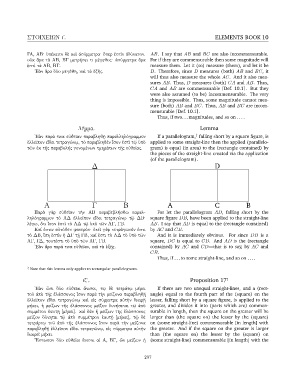
                                                                                     Lemma
                                                                                   †
               ᾿Εὰν παρά τινα εὐθεῖαν παραβληθῇ παραλληλόγραμμον   If a parallelogram, falling short by a square figure, is
            ἐλλεῖπον εἴδει τετραγώνῳ, τὸ παραβληθὲν ἴσον ἐστὶ τῷ ὑπὸ applied to some straight-line then the applied (parallelo-
            τῶν ἐκ τῆς παραβολής γενομένων τμημάτων τῆς εὐθείας.  gram) is equal (in area) to the (rectangle contained) by
                                                                the pieces of the straight-line created via the application
                                                                (of the parallelogram).
                                        ∆                                                  D


                   Α                    Γ            Β                 A                   C            B
               Παρὰ γὰρ εὐθεῖαν τὴν ΑΒ παραβεβλήσθω παραλ-         For let the parallelogram AD, falling short by the
            ληλόγραμμον τὸ ΑΔ ἐλλεῖπον εἴδει τετραγώνῳ τῷ ΔΒ· square figure DB, have been applied to the straight-line
            λέγω, ὅτι ἴσον ἐστὶ τὸ ΑΔ τῷ ὑπὸ τῶν ΑΓ, ΓΒ.        AB. I say that AD is equal to the (rectangle contained)
                                    izþ                         CB. Thus, if . . . to some straight-line, and so on . . . .
               Καί ἐστιν αὐτόθεν φανερόν· ἐπεὶ γὰρ τετράγωνόν ἐστι  by AC and CB.
            τὸ ΔΒ, ἴση ἐστὶν ἡ ΔΓ τῇ ΓΒ, καί ἐστι τὸ ΑΔ τὸ ὑπὸ τῶν  And it is immediately obvious. For since DB is a
            ΑΓ, ΓΔ, τουτέστι τὸ ὑπὸ τῶν ΑΓ, ΓΒ.                 square, DC is equal to CB. And AD is the (rectangle
               ᾿Εὰν ἄρα παρά τινα εὐθεῖαν, καὶ τὰ ἑξῆς.         contained) by AC and CD—that is to say, by AC and


            †  Note that this lemma only applies to rectangular parallelograms.
                                      .
                                                                                Proposition 17
                                                                                                †
               ᾿Εὰν ὦσι δύο εὐθεῖαι ἄνισοι, τῷ δὲ τετράτῳ μέρει    If there are two unequal straight-lines, and a (rect-
            τοῦ ἀπὸ τῆς ἐλάσσονος ἴσον παρὰ τὴν μείζονα παραβληθῇ angle) equal to the fourth part of the (square) on the
            ἐλλεῖπον εἴδει τετραγώνῳ καὶ εἰς σύμμετρα αὐτὴν διαιρῇ lesser, falling short by a square figure, is applied to the
            μήκει, ἡ μείζων τῆς ἐλάσσονος μεῖζον δυνήσεται τῷ ἀπὸ greater, and divides it into (parts which are) commen-
            συμμέτου ἑαυτῇ [μήκει]. καὶ ἐὰν ἡ μείζων τῆς ἐλάσσονος surable in length, then the square on the greater will be
            μεῖζον δύνηται τῷ ἀπὸ συμμέτρου ἑαυτῇ [μήκει], τῷ δὲ  larger than (the square on) the lesser by the (square)
            τετράρτῳ τοῦ ἀπὸ τῆς ἐλάσσονος ἴσον παρὰ τὴν μείζονα on (some straight-line) commensurable [in length] with
            παραβληθῇ ἐλλεῖπον εἴδει τετραγώνῳ, εἰς σύμμετρα αὐτὴν the greater. And if the square on the greater is larger
            διαιρεῖ μήκει.                                      than (the square on) the lesser by the (square) on
               ῎Εστωσαν δύο εὐθεῖαι ἄνισοι αἱ Α, ΒΓ, ὧν μείζων ἡ  (some straight-line) commensurable [in length] with the


                                                             297

