


Page 310 - Euclid's Elements of Geometry
P. 310
ST	EW      iþ.


                                                                                           ELEMENTS BOOK 10


            περιέχουσαι· ὅπερ ἔδει δεῖξαι.                      alternately, as B (is) to D, (so) C (is) to E [Prop. 5.16].
                                                                And as B (is) to D, (so) D (is) to A. And thus as D (is) to
                                                                A, (so) C (is) to E. Thus, the (rectangle contained) by A
                                                                and C is equal to the (rectangle contained) by D and E
                                                                [Prop. 6.16]. And the (rectangle contained) by A and C
                                                                is medial [Prop. 10.21]. Thus, the (rectangle contained)
                                ¨mma   aþ.                     taining a medial (area), (which are) commensurable in
                                                                by D and E (is) also medial.
                                                                   Thus, (two) medial (straight-lines, D and E), con-

                                                                square only, have been found. (Which is) the very thing
                                                                it was required to show.

            †  D and E have lengths k 1/4  and k ′1/2 /k  1/4  times that of A, respectively, where the lengths of B and C are k 1/2  and k  ′1/2  times that of A,
            respectively.

                                                                                    Lemma I
               Εὑρειν δύο τετραγώνους ἀριθμούς, ὥστε καὶ τὸν       To find two square numbers such that the sum of them
            συγκείμενον ἐξ αὐτῶν εἶναι τετράγωνον.              is also square.

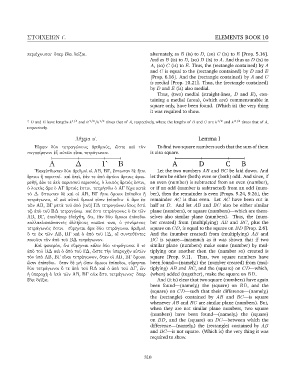
                      Α          ∆          Γ     Β                      A          D          C      B
               ᾿Εκκείσθωσαν δύο ἀριθμοὶ οἱ ΑΒ, ΒΓ, ἔστωσαν δὲ ἤτοι  Let the two numbers AB and BC be laid down. And
            ἄρτιοι ἢ περιττοί. καὶ ἐπεὶ, ἐάν τε ἀπὸ ἀρτίου ἄρτιος ἀφαι- let them be either (both) even or (both) odd. And since, if
            ρεθῇ, ἐάν τε ἀπὸ περισσοῦ περισσός, ὁ λοιπὸς ἄρτιός ἐστιν, an even (number) is subtracted from an even (number),
            ὁ λοιπὸς ἄρα ὁ ΑΓ ἄρτιός ἐστιν. τετμήσθω ὁ ΑΓ δίχα κατὰ or if an odd (number is subtracted) from an odd (num-
            τὸ Δ. ἔστωσαν δὲ καὶ οἱ ΑΒ, ΒΓ ἤτοι ὅμοιοι ἐπίπεδοι ἢ  ber), then the remainder is even [Props. 9.24, 9.26], the
            τετράγωνοι, οἳ καὶ αὐτοὶ ὅμοιοί εἰσιν ἐπίπεδοι· ὁ ἄρα ἐκ  remainder AC is thus even. Let AC have been cut in
            τῶν ΑΒ, ΒΓ μετὰ τοῦ ἀπὸ [τοῦ] ΓΔ τετραγώνου ἴσος ἐστὶ  half at D. And let AB and BC also be either similar
            τῷ ἀπὸ τοῦ ΒΔ τετραγώνῳ. καί ἐστι τετράγωνος ὁ ἐκ τῶν  plane (numbers), or square (numbers)—which are them-
            ΑΒ, ΒΓ, ἐπειδήπερ ἐδείχθη, ὅτι, ἐὰν δύο ὅμοιοι ἐπίπεδοι selves also similar plane (numbers). Thus, the (num-
            πολλαπλασιάσαντες ἀλλήλους ποιῶσι τινα, ὁ γενόμενος  ber created) from (multiplying) AB and BC, plus the
            τετράγωνός ἐστιν. εὕρηνται ἄρα δύο τετράγωνοι ἀριθμοὶ square on CD, is equal to the square on BD [Prop. 2.6].
            ὅ τε ἐκ τῶν ΑΒ, ΒΓ καὶ ὁ ἀπὸ τοῦ ΓΔ, οἳ συντεθέντες  And the (number created) from (multiplying) AB and
            ποιοῦσι τὸν ἀπὸ τοῦ ΒΔ τετράγωνον.                  BC is square—inasmuch as it was shown that if two
               Καὶ φανερόν, ὅτι εὕρηνται πάλιν δύο τετράγωνοι ὅ τε  similar plane (numbers) make some (number) by mul-
            ἀπὸ τοῦ ΒΔ καὶ ὁ ἀπὸ τοῦ ΓΔ, ὥστε τὴν ὑπεροχὴν αὐτῶν tiplying one another then the (number so) created is
            τὸν ὑπὸ ΑΒ, ΒΓ εἶναι τετράγωνον, ὅταν οἱ ΑΒ, ΒΓ ὅμοιοι square [Prop. 9.1].  Thus, two square numbers have
            ὦσιν ἐπίπεδοι. ὅταν δὲ μὴ ὦσιν ὅμοιοι ἐπίπεδοι, εὕρηνται been found—(namely,) the (number created) from (mul-
            δύο τετράγωνοι ὅ τε ἀπὸ τοῦ ΒΔ καὶ ὁ ἀπὸ τοῦ ΔΓ, ὧν  tiplying) AB and BC, and the (square) on CD—which,
            ἡ ὑπεροχὴ ὁ ὑπὸ τῶν ΑΒ, ΒΓ οὐκ ἔστι τετράγωνος· ὅπερ (when) added (together), make the square on BD.
            ἔδει δεῖξαι.                                           And (it is) clear that two square (numbers) have again
                                                                been found—(namely,) the (square) on BD, and the
                                                                (square) on CD—such that their difference—(namely,)
                                                                the (rectangle) contained by AB and BC—is square
                                                                whenever AB and BC are similar plane (numbers). But,
                                                                when they are not similar plane numbers, two square
                                                                (numbers) have been found—(namely,) the (square)
                                                                on BD, and the (square) on DC—between which the
                                                                difference—(namely,) the (rectangle) contained by AB
                                                                and BC—is not square. (Which is) the very thing it was
                                                                required to show.


                                                             310

