


Page 311 - Euclid's Elements of Geometry
P. 311
ST	EW      iþ.  ¨mma   bþ.


                                                                                           ELEMENTS BOOK 10


                                                                                    Lemma II

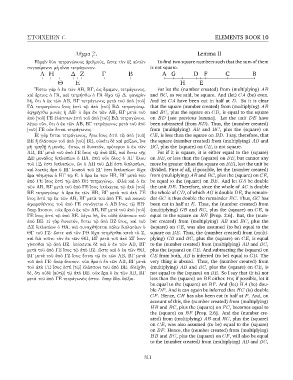
               Εὑρεῖν δύο τετραγώνους ἀριθμούς, ὥστε τὸν ἐξ αὐτῶν  To find two square numbers such that the sum of them
            συγκείμενον μὴ εἶναι τετράγωνον.                    is not square.
                  Α  Η         ∆ Ζ          Γ          Β             A G          D F          C           B
                         Θ       Ε                                          H       E
               ῎Εστω γὰρ ὁ ἐκ τῶν ΑΒ, ΒΓ, ὡς ἔφαμεν, τετράγωνος,   For let the (number created) from (multiplying) AB
            καὶ ἄρτιος ὁ ΓΑ, καὶ τετμήσθω ὁ ΓΑ δίχα τῷ Δ. φανερὸν and BC, as we said, be square. And (let) CA (be) even.
            δή, ὅτι ὁ ἐκ τῶν ΑΒ, ΒΓ τετράγωνος μετὰ τοῦ ἀπὸ [τοῦ] And let CA have been cut in half at D. So it is clear
            ΓΔ τετραγώνου ἴσος ἐστὶ τῷ ἀπὸ [τοῦ] ΒΔ τετραγώνῳ.  that the square (number created) from (multiplying) AB
            ἀφῃρήσθω μονὰς ἡ ΔΕ· ὁ ἄρα ἐκ τῶν ΑΒ, ΒΓ μετὰ τοῦ and BC, plus the square on CD, is equal to the square
            ἀπὸ [τοῦ] ΓΕ ἐλάσσων ἐστὶ τοῦ ἀπὸ [τοῦ] ΒΔ τετραγώνου. on BD [see previous lemma]. Let the unit DE have
            λέγω οὖν, ὅτι ὁ ἐκ τῶν ΑΒ, ΒΓ τετράγωνος μετὰ τοῦ ἀπὸ been subtracted (from BD). Thus, the (number created)
            [τοῦ] ΓΕ οὐκ ἔσται τετράγωνος.                      from (multiplying) AB and BC, plus the (square) on
               Εἰ γὰρ ἔσται τετράγωνος, ἤτοι ἴσος ἐστὶ τῷ ἀπὸ [τοῦ] CE, is less than the square on BD. I say, therefore, that
            ΒΕ ἢ ἐλάσσων τοῦ ἀπὸ [τοῦ] ΒΕ, οὐκέτι δὲ καὶ μείζων, ἵνα  the square (number created) from (multiplying) AB and
            μὴ τμηθῇ ἡ μονάς. ἔστω, εἰ δυνατόν, πρότερον ὁ ἐκ τῶν  BC, plus the (square) on CE, is not square.
            ΑΒ, ΒΓ μετὰ τοῦ ἀπὸ ΓΕ ἴσος τῷ ἀπὸ ΒΕ, καὶ ἔστω τῆς    For if it is square, it is either equal to the (square)
            ΔΕ μονάδος διπλασίων ὁ ΗΑ. ἐπεὶ οὖν ὅλος ὁ ΑΓ ὅλου on BE, or less than the (square) on BE, but cannot any
            τοῦ ΓΔ ἐστι διπλασίων, ὧν ὁ ΑΗ τοῦ ΔΕ ἐστι διπλασίων, more be greater (than the square on BE), lest the unit be
            καὶ λοιπὸς ἄρα ὁ ΗΓ λοιποῦ τοῦ ΕΓ ἐστι διπλασίων· δίχα divided. First of all, if possible, let the (number created)
            ἄρα τέτμηται ὁ ΗΓ τῷ Ε. ὁ ἄρα ἐκ τῶν ΗΒ, ΒΓ μετὰ τοῦ from (multiplying) AB and BC, plus the (square) on CE,
            ἀπὸ ΓΕ ἴσος ἐστὶ τῷ ἀπὸ ΒΕ τετραγώνῳ. ἀλλὰ καὶ ὁ ἐκ  be equal to the (square) on BE. And let GA be double
            τῶν ΑΒ, ΒΓ μετὰ τοῦ ἀπὸ ΓΕ ἴσος ὑπόκειται τῷ ἀπὸ [τοῦ] the unit DE. Therefore, since the whole of AC is double
            ΒΕ τετραγώνῳ· ὁ ἄρα ἐκ τῶν ΗΒ, ΒΓ μετὰ τοῦ ἀπὸ ΓΕ the whole of CD, of which AG is double DE, the remain-
            ἴσος ἐστὶ τῷ ἐκ τῶν ΑΒ, ΒΓ μετὰ τοῦ ἀπὸ ΓΕ. καὶ κοινοῦ der GC is thus double the remainder EC. Thus, GC has
            ἀφαιρεθέντος τοῦ ἀπὸ ΓΕ συνάγεται ὁ ΑΒ ἴσος τῷ ΗΒ· been cut in half at E. Thus, the (number created) from
            ὅπερ ἄτοπον. οὐκ ἄρα ὁ ἐκ τῶν ΑΒ, ΒΓ μετὰ τοῦ ἀπὸ [τοῦ] (multiplying) GB and BC, plus the (square) on CE, is
            ΓΕ ἴσος ἐστὶ τῷ ἀπὸ ΒΕ. λέγω δή, ὅτι οὐδὲ ἐλάσσων τοῦ equal to the square on BE [Prop. 2.6]. But, the (num-
            ἀπὸ ΒΕ. εἰ γὰρ δυνατόν, ἔστω τῷ ἀπὸ ΒΖ ἴσος, καὶ τοῦ ber created) from (multiplying) AB and BC, plus the
            ΔΖ διπλασίων ὁ ΘΑ. καὶ συναχθήσεται πάλιν διπλασίων ὁ  (square) on CE, was also assumed (to be) equal to the
            ΘΓ τοῦ ΓΖ· ὥστε καὶ τὸν ΓΘ δίχα τετμῆσθαι κατὰ τὸ Ζ, square on BE. Thus, the (number created) from (multi-
            καὶ διὰ τοῦτο τὸν ἐκ τῶν ΘΒ, ΒΓ μετὰ τοῦ ἀπὸ ΖΓ ἴσον plying) GB and BC, plus the (square) on CE, is equal
            γίνεσθαι τῷ ἀπὸ ΒΖ. ὑπόκειται δὲ καὶ ὁ ἐκ τῶν ΑΒ, ΒΓ  to the (number created) from (multiplying) AB and BC,
            μετὰ τοῦ ἀπὸ ΓΕ ἴσος τῷ ἀπὸ ΒΖ. ὥστε καὶ ὁ ἐκ τῶν ΘΒ, plus the (square) on CE. And subtracting the (square) on
            ΒΓ μετὰ τοῦ ἀπὸ ΓΖ ἴσος ἔσται τῷ ἐκ τῶν ΑΒ, ΒΓ μετὰ CE from both, AB is inferred (to be) equal to GB. The
            τοῦ ἀπὸ ΓΕ· ὅπερ ἄτοπον. οὐκ ἄρα ὁ ἐκ τῶν ΑΒ, ΒΓ μετὰ very thing is absurd. Thus, the (number created) from
            τοῦ ἀπὸ ΓΕ ἴσος ἐστὶ [τῷ] ἐλάσσονι τοῦ ἀπὸ ΒΕ. ἐδείχθη (multiplying) AB and BC, plus the (square) on CE, is
            δέ, ὅτι οὐδὲ [αὐτῷ] τῷ ἀπὸ ΒΕ. οὐκ ἄρα ὁ ἐκ τῶν ΑΒ, ΒΓ  not equal to the (square) on BE. So I say that (it is) not
            μετὰ τοῦ ἀπὸ ΓΕ τετράγωνός ἐστιν. ὅπερ ἔδει δεῖξαι.  less than the (square) on BE either. For, if possible, let it
                                                                be equal to the (square) on BF. And (let) HA (be) dou-
                                                                ble DF. And it can again be inferred that HC (is) double
                                                                CF. Hence, CH has also been cut in half at F. And, on
                                                                account of this, the (number created) from (multiplying)
                                                                HB and BC, plus the (square) on FC, becomes equal to
                                                                the (square) on BF [Prop. 2.6]. And the (number cre-
                                                                ated) from (multiplying) AB and BC, plus the (square)
                                                                on CE, was also assumed (to be) equal to the (square)
                                                                on BF. Hence, the (number created) from (multiplying)
                                                                HB and BC, plus the (square) on CF, will also be equal
                                                                to the (number created) from (multiplying) AB and BC,


                                                             311

