


Page 312 - Euclid's Elements of Geometry
P. 312
ST	EW      iþ.                                                             ELEMENTS BOOK 10


                                   kjþ                          plus the (square) on CE. The very thing is absurd. Thus,
                                                                the (number created) from (multiplying) AB and BC,
                                                                plus the (square) on CE, is not equal to less than the
                                                                (square) on BE. And it was shown that (is it) not equal
                                                                to the (square) on BE either. Thus, the (number created)
                                                                from (multiplying) AB and BC, plus the square on CE,
                                                                is not square. (Which is) the very thing it was required to
                                                                show.

                                      .
                                                                                 Proposition 29
               Εὑρεῖν δύο ῥητὰς δυνάμει μόνον συμμέτρους, ὥστε τὴν  To find two rational (straight-lines which are) com-
            μείζονα τῆς ἐλάσσονος μεῖζον δύνασθαι τῷ ἀπὸ συμμέτρου mensurable in square only, such that the square on the
            ἑαυτῇ μήκει.                                        greater is larger than the (square on the) lesser by the
                                                                (square) on (some straight-line which is) commensurable
                                                                in length with the greater.
                                            Ζ                                                   F


                     Α                           Β                      A                            B


                     Γ            Ε                ∆                    C            E                 D
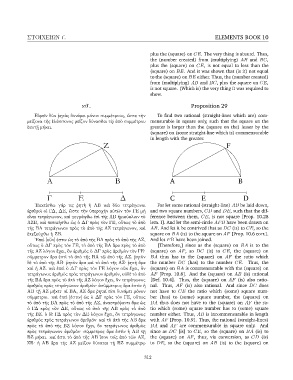
               ᾿Εκκείσθω γάρ τις ῥητὴ ἡ ΑΒ καὶ δύο τετράγωνοι      For let some rational (straight-line) AB be laid down,
            ἀριθμοὶ οἱ ΓΔ, ΔΕ, ὥστε τὴν ὑπεροχὴν αὐτῶν τὸν ΓΕ μὴ  and two square numbers, CD and DE, such that the dif-
            εἶναι τετράγωνον, καὶ γεγράφθω ἐπὶ τῆς ΑΒ ἡμικύκλιον τὸ  ference between them, CE, is not square [Prop. 10.28
            ΑΖΒ, καὶ πεποιήσθω ὡς ὁ ΔΓ πρὸς τὸν ΓΕ, οὕτως τὸ ἀπὸ lem. I]. And let the semi-circle AFB have been drawn on
            τῆς ΒΑ τετράγωνον πρὸς τὸ ἀπὸ τῆς ΑΖ τετράγωνον, καὶ AB. And let it be contrived that as DC (is) to CE, so the
            ἐπεζεύχθω ἡ ΖΒ.                                     square on BA (is) to the square on AF [Prop. 10.6 corr.].
               ᾿Επεὶ [οὖν] ἐστιν ὡς τὸ ἀπὸ τῆς ΒΑ πρὸς τὸ ἀπὸ τῆς ΑΖ, And let FB have been joined.
            οὕτως ὁ ΔΓ πρὸς τὸν ΓΕ, τὸ ἀπὸ τῆς ΒΑ ἄρα πρὸς τὸ ἀπὸ  [Therefore,] since as the (square) on BA is to the
            τῆς ΑΖ λόγον ἔχει, ὅν ἀριθμὸς ὁ ΔΓ πρὸς ἀριθμὸν τὸν ΓΕ· (square) on AF, so DC (is) to CE, the (square) on
            σύμμετρον ἄρα ἐστὶ τὸ ἀπὸ τῆς ΒΑ τῷ ἀπὸ τῆς ΑΖ. ῥητὸν BA thus has to the (square) on AF the ratio which
            δὲ τὸ ἀπὸ τῆς ΑΒ· ῥητὸν ἄρα καὶ τὸ ἀπὸ τῆς ΑΖ· ῥητὴ ἄρα the number DC (has) to the number CE. Thus, the
            καὶ ἡ ΑΖ. καὶ ἐπεὶ ὁ ΔΓ πρὸς τὸν ΓΕ λόγον οὐκ ἔχει, ὃν (square) on BA is commensurable with the (square) on
            τετράγωνος ἀριθμὸς πρὸς τετράγωνον ἀριθμόν, οὐδὲ τὸ ἀπὸ AF [Prop. 10.6]. And the (square) on AB (is) rational
            τῆς ΒΑ ἄρα πρὸς τὸ ἀπὸ τῆς ΑΖ λόγον ἔχει, ὃν τετράγωνος  [Def. 10.4]. Thus, the (square) on AF (is) also ratio-
            ἀριθμὸς πρὸς τετράγωνον ἀριθμόν· ἀσύμμετρος ἄρα ἐστὶν ἡ  nal. Thus, AF (is) also rational. And since DC does
            ΑΒ τῇ ΑΖ μήκει· αἱ ΒΑ, ΑΖ ἄρα ῥηταί εἰσι δυνάμει μόνον not have to CE the ratio which (some) square num-
            σύμμετροι. καὶ ἐπεί [ἐστιν] ὡς ὁ ΔΓ πρὸς τὸν ΓΕ, οὕτως ber (has) to (some) square number, the (square) on
            τὸ ἀπὸ τῆς ΒΑ πρὸς τὸ ἀπὸ τῆς ΑΖ, ἀναστρέψαντι ἄρα ὡς  BA thus does not have to the (square) on AF the ra-
            ὁ ΓΔ πρὸς τὸν ΔΕ, οὕτως τὸ ἀπὸ τῆς ΑΒ πρὸς τὸ ἀπὸ tio which (some) square number has to (some) square
            τῆς ΒΖ. ὁ δὲ ΓΔ πρὸς τὸν ΔΕ λόγον ἔχει, ὃν τετράγωνος  number either. Thus, AB is incommensurable in length
            ἀριθμὸς πρὸς τετράγωνον ἀριθμόν· καὶ τὸ ἀπὸ τῆς ΑΒ ἄρα with AF [Prop. 10.9]. Thus, the rational (straight-lines)
            πρὸς τὸ ἀπὸ τῆς ΒΖ λόγον ἔχει, ὃν τετράγωνος ἀριθμὸς BA and AF are commensurable in square only. And
            πρὸς τετράγωνον ἀριθμόν· σύμμετρος ἄρα ἐστὶν ἡ ΑΒ τῇ  since as DC [is] to CE, so the (square) on BA (is) to
            ΒΖ μήκει. καί ἐστι τὸ ἀπὸ τῆς ΑΒ ἴσον τοῖς ἀπὸ τῶν ΑΖ, the (square) on AF, thus, via conversion, as CD (is)
            ΖΒ· ἡ ΑΒ ἄρα τῆς ΑΖ μεῖζον δύναται τῇ ΒΖ συμμέτρῳ to DE, so the (square) on AB (is) to the (square) on

                                                             312

