


Page 45 - Euclid's Elements of Geometry
P. 45
ST	EW      aþ.


                                                                                            ELEMENTS BOOK 1


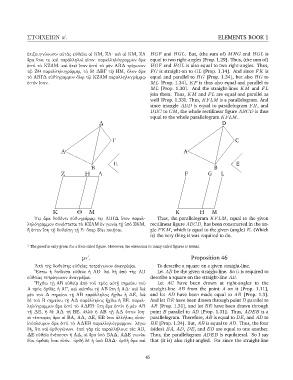
            ἐπιζευγνύουσιν αὐτὰς εὐθεῖαι αἱ ΚΜ, ΖΛ· καὶ αἱ ΚΜ, ΖΛ HGF and HGL. But, (the sum of) MHG and HGL is
            ἄρα ἴσαι τε καὶ παράλληλοί εἰσιν· παραλληλόγραμμον ἄρα equal to two right-angles [Prop. 1.29]. Thus, (the sum of)
            ἐστὶ τὸ ΚΖΛΜ. καὶ ἐπεὶ ἴσον ἐστὶ τὸ μὲν ΑΒΔ τρίγωνον  HGF and HGL is also equal to two right-angles. Thus,
            τῷ ΖΘ παραλληλογράμμῳ, τὸ δὲ ΔΒΓ τῷ ΗΜ, ὅλον ἄρα FG is straight-on to GL [Prop. 1.14]. And since FK is
            τὸ ΑΒΓΔ εὐθύγραμμον ὅλῳ τῷ ΚΖΛΜ παραλληλογράμμῳ equal and parallel to HG [Prop. 1.34], but also HG to
            ἐστὶν ἴσον.                                         ML [Prop. 1.34], KF is thus also equal and parallel to
                                                                ML [Prop. 1.30]. And the straight-lines KM and FL
                                                                join them. Thus, KM and FL are equal and parallel as
                                                                well [Prop. 1.33]. Thus, KFLM is a parallelogram. And
                                                                since triangle ABD is equal to parallelogram FH, and
                                                                DBC to GM, the whole rectilinear figure ABCD is thus
                                                                equal to the whole parallelogram KFLM.
                                          ∆                                                   D


                                                Γ                                                  C

                          Α                                                   A

                                                Ε                                                   E
                                       Β                                                  B
                          Ζ          Η    Λ                                   F         G    L


                                   mþ                          is) the very thing it was required to do.
                       Κ         Θ    Μ                                   K          H    M
               Τῷ ἄρα δοθέντι εὐθυγράμμῳ τῷ ΑΒΓΔ ἴσον παραλ-       Thus, the parallelogram KFLM, equal to the given
            ληλόγραμμον συνέσταται τὸ ΚΖΛΜ ἐν γωνίᾳ τῇ ὑπὸ ΖΚΜ, rectilinear figure ABCD, has been constructed in the an-
            ἥ ἐστιν ἴση τῇ δοθείσῃ τῇ Ε· ὅπερ ἔδει ποιῆσαι.     gle FKM, which is equal to the given (angle) E. (Which


            †  The proof is only given for a four-sided figure. However, the extension to many-sided figures is trivial.
                                                                                 Proposition 46
                                      .
               ᾿Απὸ τῆς δοθείσης εὐθείας τετράγωνον ἀναγράψαι.     To describe a square on a given straight-line.
               ῎Εστω ἡ δοθεῖσα εὐθεῖα ἡ ΑΒ· δεῖ δὴ ἀπὸ τῆς ΑΒ      Let AB be the given straight-line. So it is required to
            εὐθείας τετράγωνον ἀναγράψαι.                       describe a square on the straight-line AB.
               ῎Ηχθω τῇ ΑΒ εὐθείᾳ ἀπὸ τοῦ πρὸς αὐτῇ σημείου τοῦ    Let AC have been drawn at right-angles to the
            Α πρὸς ὀρθὰς ἡ ΑΓ, καὶ κείσθω τῇ ΑΒ ἴση ἡ ΑΔ· καὶ διὰ straight-line AB from the point A on it [Prop. 1.11],
            μὲν τοῦ Δ σημείου τῇ ΑΒ παράλληλος ἤχθω ἡ ΔΕ, διὰ and let AD have been made equal to AB [Prop. 1.3].
            δὲ τοῦ Β σημείου τῇ ΑΔ παράλληλος ἤχθω ἡ ΒΕ. παραλ- And let DE have been drawn through point D parallel to
            ληλόγραμμον ἄρα ἐστὶ τὸ ΑΔΕΒ· ἴση ἄρα ἐστὶν ἡ μὲν ΑΒ  AB [Prop. 1.31], and let BE have been drawn through
            τῇ ΔΕ, ἡ δὲ ΑΔ τῇ ΒΕ. ἀλλὰ ἡ ΑΒ τῇ ΑΔ ἐστιν ἴση· point B parallel to AD [Prop. 1.31]. Thus, ADEB is a
            αἱ τέσσαρες ἄρα αἱ ΒΑ, ΑΔ, ΔΕ, ΕΒ ἴσαι ἀλλήλαις εἰσίν· parallelogram. Therefore, AB is equal to DE, and AD to
            ἰσόπλευρον ἄρα ἐστὶ τὸ ΑΔΕΒ παραλληλόγραμμον. λέγω BE [Prop. 1.34]. But, AB is equal to AD. Thus, the four
            δή, ὅτι καὶ ὀρθογώνιον. ἐπεὶ γὰρ εἰς παραλλήλους τὰς ΑΒ, (sides) BA, AD, DE, and EB are equal to one another.
            ΔΕ εὐθεῖα ἐνέπεσεν ἡ ΑΔ, αἱ ἄρα ὑπὸ ΒΑΔ, ΑΔΕ γωνίαι  Thus, the parallelogram ADEB is equilateral. So I say
            δύο ὀρθαῖς ἴσαι εἰσίν. ὀρθὴ δὲ ἡ ὑπὸ ΒΑΔ· ὀρθὴ ἄρα καὶ that (it is) also right-angled. For since the straight-line


                                                              45

