


Page 46 - Euclid's Elements of Geometry
P. 46
ST	EW      aþ.


                                                                                            ELEMENTS BOOK 1


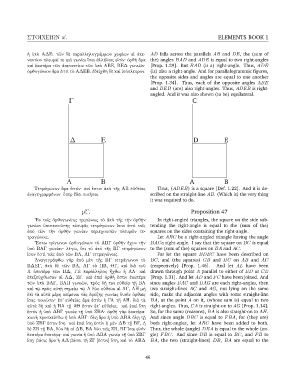
            ἡ ὑπὸ ΑΔΕ. τῶν δὲ παραλληλογράμμων χωρίων αἱ ἀπε- AD falls across the parallels AB and DE, the (sum of
            ναντίον πλευραί τε καὶ γωνίαι ἴσαι ἀλλήλαις εἰσίν· ὀρθὴ ἄρα the) angles BAD and ADE is equal to two right-angles
            καὶ ἑκατέρα τῶν ἀπεναντίον τῶν ὑπὸ ΑΒΕ, ΒΕΔ γωνιῶν·  [Prop. 1.29]. But BAD (is a) right-angle. Thus, ADE
            ὀρθογώνιον ἄρα ἐστὶ τὸ ΑΔΕΒ. ἐδείχθη δὲ καὶ ἰσόπλευρον. (is) also a right-angle. And for parallelogrammic figures,
                                                                the opposite sides and angles are equal to one another
                                                                [Prop. 1.34]. Thus, each of the opposite angles ABE
                                                                and BED (are) also right-angles. Thus, ADEB is right-
                                                                angled. And it was also shown (to be) equilateral.
                              Γ                                                  C


                              ∆            Ε                                      D            E


                                   mzþ


                             Α             Β                                    A              B
               Τετράγωνον ἄρα ἐστίν· καί ἐστιν ἀπὸ τῆς ΑΒ εὐθείας  Thus, (ADEB) is a square [Def. 1.22]. And it is de-
            ἀναγεγραμμένον· ὅπερ ἔδει ποιῆσαι.                  scribed on the straight-line AB. (Which is) the very thing
                                                                it was required to do.
                                      .
                                                                                 Proposition 47
               ᾿Εν τοῖς ὀρθογωνίοις τριγώνοις τὸ ἀπὸ τῆς τὴν ὀρθὴν  In right-angled triangles, the square on the side sub-
            γωνίαν ὑποτεινούσης πλευρᾶς τετράγωνον ἴσον ἐστὶ τοῖς tending the right-angle is equal to the (sum of the)
            ἀπὸ τῶν τὴν ὀρθὴν γωνίαν περιεχουσῶν πλευρῶν τε- squares on the sides containing the right-angle.
            τραγώνοις.                                             Let ABC be a right-angled triangle having the angle
               ῎Εστω τρίγωνον ὀρθογώνιον τὸ ΑΒΓ ὀρθὴν ἔχον τὴν BACa right-angle. I say that the square on BC is equal
            ὑπὸ ΒΑΓ γωνίαν· λέγω, ὅτι τὸ ἀπὸ τῆς ΒΓ τετράγωνον to the (sum of the) squares on BA and AC.
            ἴσον ἐστὶ τοῖς ἀπὸ τῶν ΒΑ, ΑΓ τετραγώνοις.             For let the square BDEC have been described on
               ᾿Αναγεγράφθω γὰρ ἀπὸ μὲν τῆς ΒΓ τετράγωνον τὸ    BC, and (the squares) GB and HC on AB and AC
            ΒΔΕΓ, ἀπὸ δὲ τῶν ΒΑ, ΑΓ τὰ ΗΒ, ΘΓ, καὶ διὰ τοῦ (respectively) [Prop. 1.46].     And let AL have been
            Α ὁποτέρᾳ τῶν ΒΔ, ΓΕ παράλληλος ἤχθω ἡ ΑΛ· καὶ drawn through point A parallel to either of BD or CE
            ἐπεζεύχθωσαν αἱ ΑΔ, ΖΓ. καὶ ἐπεὶ ὀρθή ἐστιν ἑκατέρα [Prop. 1.31]. And let AD and FC have been joined. And
            τῶν ὑπὸ ΒΑΓ, ΒΑΗ γωνιῶν, πρὸς δή τινι εὐθείᾳ τῇ ΒΑ since angles BAC and BAG are each right-angles, then
            καὶ τῷ πρὸς αὐτῇ σημείῳ τῷ Α δύο εὐθεῖαι αἱ ΑΓ, ΑΗ μὴ  two straight-lines AC and AG, not lying on the same
            ἐπὶ τὰ αὐτὰ μέρη κείμεναι τὰς ἐφεξῆς γωνίας δυσὶν ὀρθαῖς side, make the adjacent angles with some straight-line
            ἴσας ποιοῦσιν· ἐπ᾿ εὐθείας ἄρα ἐστὶν ἡ ΓΑ τῇ ΑΗ. διὰ τὰ  BA, at the point A on it, (whose sum is) equal to two
            αὐτὰ δὴ καὶ ἡ ΒΑ τῇ ΑΘ ἐστιν ἐπ᾿ εὐθείας. καὶ ἐπεὶ ἴση right-angles. Thus, CA is straight-on to AG [Prop. 1.14].
            ἐστὶν ἡ ὑπὸ ΔΒΓ γωνία τῇ ὑπὸ ΖΒΑ· ὀρθὴ γὰρ ἑκατέρα· So, for the same (reasons), BA is also straight-on to AH.
            κοινὴ προσκείσθω ἡ ὑπὸ ΑΒΓ· ὅλη ἄρα ἡ ὑπὸ ΔΒΑ ὅλῃ τῇ  And since angle DBC is equal to FBA, for (they are)
            ὑπὸ ΖΒΓ ἐστιν ἴση. καὶ ἐπεὶ ἴση ἐστὶν ἡ μὲν ΔΒ τῇ ΒΓ, ἡ  both right-angles, let ABC have been added to both.
            δὲ ΖΒ τῇ ΒΑ, δύο δὴ αἱ ΔΒ, ΒΑ δύο ταῖς ΖΒ, ΒΓ ἴσαι εἰσὶν Thus, the whole (angle) DBA is equal to the whole (an-
            ἑκατέρα ἑκατέρᾳ· καὶ γωνία ἡ ὑπὸ ΔΒΑ γωνίᾳ τῇ ὑπὸ ΖΒΓ gle) FBC. And since DB is equal to BC, and FB to
            ἴση· βάσις ἄρα ἡ ΑΔ βάσει τῇ ΖΓ [ἐστιν] ἴση, καὶ τὸ ΑΒΔ BA, the two (straight-lines) DB, BA are equal to the


                                                              46

