


Page 48 - Euclid's Elements of Geometry
P. 48
ST	EW      aþ.     mhþ                                                      ELEMENTS BOOK 1


                                      .
                                                                                 Proposition 48
               ᾿Εὰν τριγώνου τὸ ἀπὸ μιᾶς τῶν πλευρῶν τετράγωνον    If the square on one of the sides of a triangle is equal
            ἴσον ᾖ τοῖς ἀπὸ τῶν λοιπῶν τοῦ τριγώνου δύο πλευρῶν to the (sum of the) squares on the two remaining sides of
            τετραγώνοις, ἡ περιεχομένη γωνία ὑπὸ τῶν λοιπῶν τοῦ the triangle then the angle contained by the two remain-
            τριγώνου δύο πλευρῶν ὀρθή ἐστιν.                    ing sides of the triangle is a right-angle.
                                     Γ                                                  C


                          ∆         Α         Β                               D         A         B
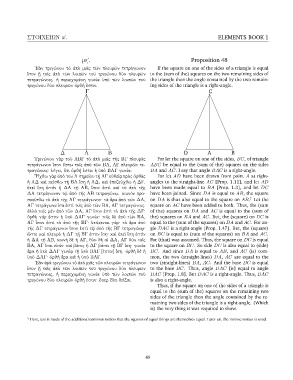
               Τριγώνου γὰρ τοῦ ΑΒΓ τὸ ἀπὸ μιᾶς τῆς ΒΓ πλευρᾶς     For let the square on one of the sides, BC, of triangle
            τετράγωνον ἴσον ἔστω τοῖς ἀπὸ τῶν ΒΑ, ΑΓ πλευρῶν τε- ABC be equal to the (sum of the) squares on the sides
            τραγώνοις· λέγω, ὅτι ὀρθή ἐστιν ἡ ὑπὸ ΒΑΓ γωνία.    BA and AC. I say that angle BAC is a right-angle.
               ῎Ηχθω γὰρ ἀπὸ τοῦ Α σημείου τῇ ΑΓ εὐθείᾳ πρὸς ὀρθὰς  For let AD have been drawn from point A at right-
            ἡ ΑΔ καὶ κείσθω τῇ ΒΑ ἴση ἡ ΑΔ, καὶ ἐπεζεύχθω ἡ ΔΓ. angles to the straight-line AC [Prop. 1.11], and let AD
            ἐπεὶ ἴση ἐστὶν ἡ ΔΑ τῇ ΑΒ, ἴσον ἐστὶ καὶ τὸ ἀπὸ τῆς have been made equal to BA [Prop. 1.3], and let DC
            ΔΑ τετράγωνον τῷ ἀπὸ τῆς ΑΒ τετραγώνῳ. κοινὸν προ- have been joined. Since DA is equal to AB, the square
                                                                                                          †
            σκείσθω τὸ ἀπὸ τῆς ΑΓ τετράγωνον· τὰ ἄρα ἀπὸ τῶν ΔΑ,  on DA is thus also equal to the square on AB. Let the
            ΑΓ τετράγωνα ἴσα ἐστὶ τοῖς ἀπὸ τῶν ΒΑ, ΑΓ τετραγώνοις. square on AC have been added to both. Thus, the (sum
            ἀλλὰ τοῖς μὲν ἀπὸ τῶν ΔΑ, ΑΓ ἴσον ἐστὶ τὸ ἀπὸ τῆς ΔΓ· of the) squares on DA and AC is equal to the (sum of
            ὀρθὴ γάρ ἐστιν ἡ ὑπὸ ΔΑΓ γωνία· τοῖς δὲ ἀπὸ τῶν ΒΑ, the) squares on BA and AC. But, the (square) on DC is
            ΑΓ ἴσον ἐστὶ τὸ ἀπὸ τῆς ΒΓ· ὑπόκειται γάρ· τὸ ἄρα ἀπὸ equal to the (sum of the squares) on DA and AC. For an-
            τῆς ΔΓ τετράγωνον ἴσον ἐστὶ τῷ ἀπὸ τῆς ΒΓ τετραγώνῳ·  gle DAC is a right-angle [Prop. 1.47]. But, the (square)
            ὥστε καὶ πλευρὰ ἡ ΔΓ τῇ ΒΓ ἐστιν ἴση· καὶ ἐπεὶ ἴση ἐστὶν on BC is equal to (sum of the squares) on BA and AC.
            ἡ ΔΑ τῇ ΑΒ, κοινὴ δὲ ἡ ΑΓ, δύο δὴ αἱ ΔΑ, ΑΓ δύο ταῖς For (that) was assumed. Thus, the square on DC is equal
            ΒΑ, ΑΓ ἴσαι εἰσίν· καὶ βάσις ἡ ΔΓ βάσει τῇ ΒΓ ἴση· γωνία  to the square on BC. So side DC is also equal to (side)
            ἄρα ἡ ὑπὸ ΔΑΓ γωνίᾳ τῇ ὑπὸ ΒΑΓ [ἐστιν] ἴση. ὀρθὴ δὲ ἡ  BC. And since DA is equal to AB, and AC (is) com-
            ὑπὸ ΔΑΓ· ὀρθὴ ἄρα καὶ ἡ ὑπὸ ΒΑΓ.                    mon, the two (straight-lines) DA, AC are equal to the
               ᾿Εὰν ἀρὰ τριγώνου τὸ ἀπὸ μιᾶς τῶν πλευρῶν τετράγωνον two (straight-lines) BA, AC. And the base DC is equal
            ἴσον ᾖ τοῖς ἀπὸ τῶν λοιπῶν τοῦ τριγώνου δύο πλευρῶν to the base BC. Thus, angle DAC [is] equal to angle
            τετραγώνοις, ἡ περιεχομένη γωνία ὑπὸ τῶν λοιπῶν τοῦ BAC [Prop. 1.8]. But DAC is a right-angle. Thus, BAC
            τριγώνου δύο πλευρῶν ὀρθή ἐστιν· ὅπερ ἔδει δεῖξαι.  is also a right-angle.
                                                                   Thus, if the square on one of the sides of a triangle is
                                                                equal to the (sum of the) squares on the remaining two
                                                                sides of the triangle then the angle contained by the re-
                                                                maining two sides of the triangle is a right-angle. (Which
                                                                is) the very thing it was required to show.

            †  Here, use is made of the additional common notion that the squares of equal things are themselves equal. Later on, the inverse notion is used.


                                                              48

