


Page 187 - ...........
P. 187
Activity 12.2


            Keep  w riting  the
            sequence  of white
            keys  from  left  to
            right as follows, like:
            CO  DO  EO  FOGO  AO
            BO  Cl  D2  E2 .........
            Keep  writing  like
            this.

            If you play Cl after        ID
            CO, you will find that  L.....-_   _,_ _   ____....__ _   _.__ _   __.. ____________ ____,
            Cl has a higher pitch
            than CO  because Cl
            is exactly one octave
            higher  than  CO.  It
            is  the  same  note
            but the frequencies
            between  the  t wo
            keys  are  different.
            The  ratio  between
            the  frequencies  of                                               ~o
            Cl  and  CO  is  2:1.
            The  seven  natural
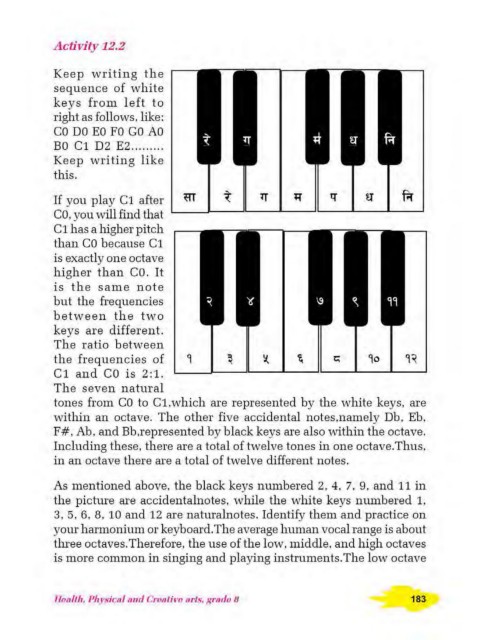
            tones from CO  to Cl,which are represented by the white keys,  are
            within an octave.  The other five  accidental  notes,namely Db, Eb,
            F#, Ab, and Bb,represented by black keys are also within the octave.
            Including these, there are a total of twelve tones in one octave.Thus,
            in an octave there are a total of twelve different notes.

            As  mentioned above, the black keys numbered 2, 4,  7,  9, and 11 in
            the picture are accidentalnotes, while the white keys  numbered 1,
            3,  5, 6,  8, 10 and 12 are naturalnotes. Identify them and practice on
            your harmonium or keyboard.The average human vocal range is about
            three octaves. Therefore, the use of the low, middle, and high octaves
            is more common in singing and playing instruments. The low octave


            Tlo11/Lh, Physicnl and Crrmlivo 11rl.'>,  grnrln 0                           183

