


Page 191 - ...........
P. 191
(Note: Since there is a gap of only half-steps between E and Fas well
            as between B and C, there are no other notes between these two notes,
            there is no way to omit notes here.)

            (e)  Now skip the Tivra Ma (F#) and move one note up to Pa (G).

            (f)  Leave the Kamal Dha (Ab) and move one note up to ShuddhaDha
                  (A).

            (g)  Leave the Komal Ni (Bb) and move one note up to ShuddhaNi (B).

            (h)  Since there is  no other note between Ni (B)  and Sa (C), move
                  directly up to Sa (C).

                                                   1/2
                        Major Scale Formula        ,.---....
                  ~ ~ -- -            ~


                   c  D  E  F  G  A  B  c
                    LJI    I   I   LJLJLJ
                     W  W  H  W  W  W  H
                         WhOUI St.p · Wf\Olt S"P  Halt S1•p ·
                      Whole Sti9p • W~• St.p ·  Wbot. Slejt ·  Half SI.,
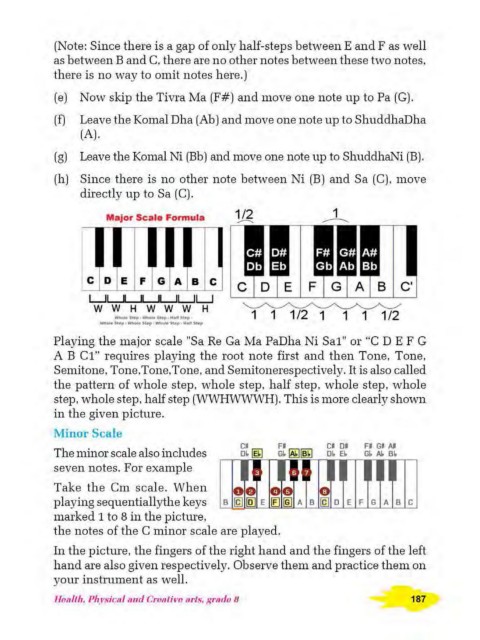
            Playing the major scale "Sa Re  Ga Ma PaDha Ni Sal" or "CD EFG
            A  B Cl"  requires playing the root note first  and then Tone,  Tone,
            Semitone, Tone, Tone, Tone, and Semitonerespectively. It is also called
            the pattern of whole step, whole step, half step, whole step, whole
            step, whole step, half step (WWHWWWH). This is inore clearly shown
            in the given picture.

            Minor Scale

            The minor scale also includes
            seven notes. For example
            Take  the  Cm scale.  When             09  GO            0
            playing sequentiallythe keys        a  1£] [Q]  E  [] !§]  A  a  1£]  o  E  F  G  A  a  c
            marked 1 to 8 in the picture,
            the notes of the C minor scale are played.
            In the picture, the fingers of the right hand and the fingers of the left
            hand are also given respectively. Observe them and practice them on
            your instrument as well.

            Tlo11/Lh,  Physicnl and Crrmlivo nrl.'>, grnrln 0                            187

