


Page 189 - ...........
P. 189
(c)     Scale
            A scale is a set of musical notes ordered by fundamental frequencies or
            pitches based on the principles of music theory. If the scale starts with
            the note which has the lowest pitch and goes up to the note with the
            highest pitch, the scale is called ascending. If the scale starts with the
            note which has the highest pitch and goes down to the note with the
            lowest pitch, the scale is called descending. Songs are composed based
            on scales. Scales are the building blocks of any musical composition.
            The scale of the song is determined by examining the nature of the
            song and the singer. These scales can be major, minor, chromatic, etc.
            In one octave, there are 12 major, minor, and chrmnatic scales. When
            a song is created based on a certain scale, the notes of that song follow
            that scale. There are two processes to identify the notes in the scale:

            First process:

            The first process is to move in one interval at a time. An interval is the
            distance between two notes. For example, moving frmn Sa to Kamal
            Re  or from Kamal Re  to Shuddha Re,  etc. This interval is  called a
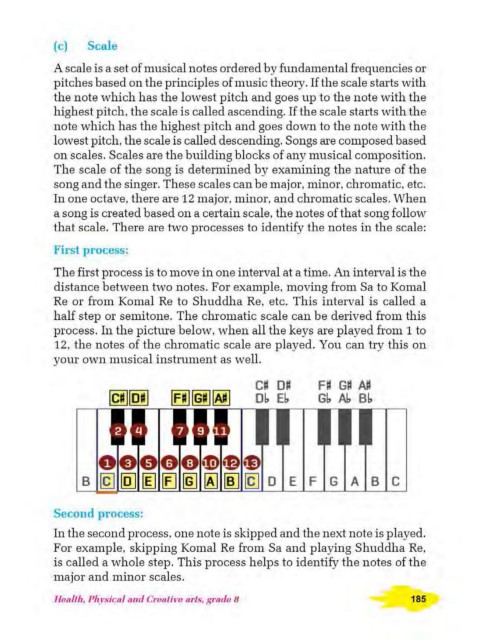
            half step or semitone. The chromatic scale can be derived from this
            process. In the picture below, when all the keys are played fro111  1 to
            12, the notes of the chromatic scale are played. You can try this on
            your own musical instrument as well.

                                                       CM  OM        FM  GM  A.II
                                                       Db Eb         Gb AJ,  Bb


            Second process:
            In the second process, one note is skipped and the next note is played.
            For example,  skipping Kamal Re  fron~ Sa and playing Shuddha Re,
            is called a whole step. This process helps to identify the notes of the
            major and minor scales.

            Tlo11/Lh,  Physicnl and Crrmlivo nrl.'>, grnrln 0                            185

