


Page 188 - ...........
P. 188
'
                                                     '
               re          rn'a  dha  ni   re  ga   ma dha  ni     re   ~      ma dha  ni
               -   ~      -       -                         -                         -
                           ~ u  fit
                                                    ~ tr  fit
                i
                                         t  '1T
                                                                                 - -
             - -   dT  .--...-- ..... - - - ,_  --..-- .-.- --...... -  ,.- - i  ~   ~ tr  ~
                                                                     ,....
                                                                         .--......-
                                                                                      - ,.-
             'sa  're  'ga  'ma 'pa  'dha  'ni  sa  re  ga  ma  pa  dha  ni  sa'  re  ga'  ma  pa  dha  n i'
                                       ~ ~  <1T  ~  er  q
             ':R"T  ~  7T  ':Ff"  er  9-T  ~                 ~        ~  7t  ~  tj- u   ~
                                                                 Im


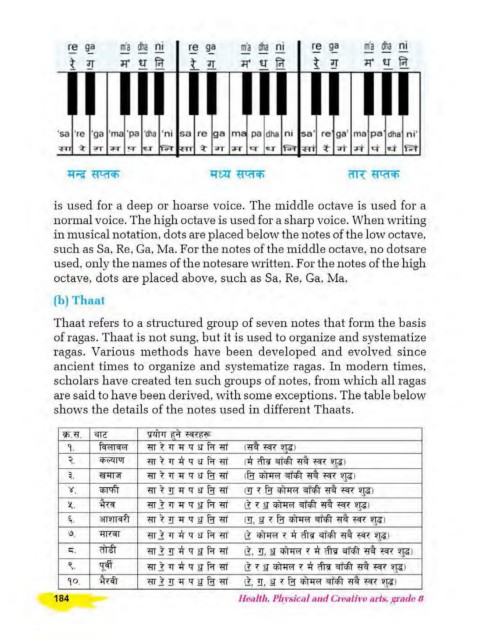
            is used for a deep or hoarse voice.  The middle octave is used for a
            normal voice. The high octave is used for a sharp voice. When writing
            in musical notation, dots are placed below the notes of the low octave,
            such as Sa, Re, Ga, Ma. For the notes of the middle octave, no dotsare
            used, only the names of the notesare written. For the notes of the high
            octave, dots are placed above, such as Sa, Re, Ga, Ma.

            (b) Thaat

            Thaat refers to a structured group of seven notes that form the basis
            of ragas. Thaat is not sung, but it is used to organize and systematize
            ragas.  Various  methods  have been developed and evolved since
            ancient times to organize and systematize ragas. In modern times,
            scholars have created ten such groups of notes, from which all ragas
            are said to have been derived, with some exceptions. The table below
            shows the details of the notes used in different Thaats.

              91.~.  me         ~~~
                                mzTf+r~n.rR-m  <~ m  '!!-ra:l
               9.     ~
               ~-     ~  mtTf-tr~nrR"m  <* <f1g  zj'$T  ~ m  '!!~l
               ~-     ~  mzTf+r1l~fum  <fu~~~m~i
               ¥      ~  m't!r+r1l~fum  <!TZB~~~m'!!~l
               x.     ~         m.JTf+r1lYRm         crzy ~~~m '!!~)
               ~-     amwrt'T   m'tTI11qyf3"m        m, y z 6  ~ zj'$T ~ m  ~i
                                                             z
               \.9    llT'{C{T   mllTir1lCTRm        cr  ~ * <f1g iSITctr ~ m  '!!~)
                                                                  z
               c;,    ffi"tr    mlTiif qyf;fm        cr,  !T,  y  ~ * <f1g  ~ ~ m  \_-ra:)
               '\.    qcff      m.!Tfifqyf;fm        ITZN~Z lr~~~ffi '!!~)
                      "'
               90     m<fl      m.!TI11qyfum  cr,  TI, y z 6  ~ ~ ~ m  ~)
            184                                     Ilealth. Physical m1d l.J.·eative m·ts. grnde 8

