


Page 250 - D&D Bestiary
P. 250
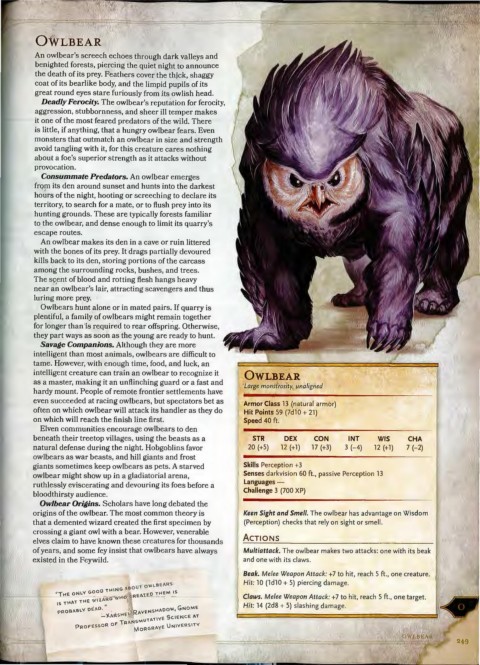
OWLBEAR
         An owlbear's screech echoes through dark valleys and
         benighted forests, piercing the quiet night to announce
         the death of its prey. Feathers cover the thick, shaggy
         coat of its bearlike body, and the limpid pupils of its
         great round eyes stare furiously from its owlish head.
           Deadly Ferocity. The owlbear's reputation for ferocity,
         aggression, stubbornnes~. and sheer ill temper makes
         it one of the most feared predators of the wild. There
         is little, if anything, that a hungry owlbear fears. Even
         monsters that outmatch an owlbear in size and strength
         avoid tangling with it, for this creature cares nothing
         about a foe's superior strength as it attacks without
         provocation.
           Consummate Predators. An owl bear emerges
         from its den around sunset and hunts into the darkest
         hours of the night, hooting or screeching to declare its
         territory, to search for a mate, or to flush prey into its
         hunting grounds. These are typically forests familiar
         to the owlbear, and dense enough to limit its quarry's
         escape routes.
           An owlbear makes its den in a cave or ruin littered
         with the bones of its prey. It drags partially devoured
         kills back to its den, storing portions of the carcass
         among the surrounding rocks, bushes, and trees.
         The scent of blood and rotting flesh hangs heavy
         near an owlbear's lair, attracting scavengers and thus
         luring more prey.
           Owl  bears hunt alone or in mated pairs. If quarry is
         plentiful, a family of owlbears might remain together
         for longer than 'is required to rear offspring. Otherwise,
         they part ways as soon as the young are ready to hunt.
          Savage Companions. Although they are more
         intelligent than most animals, owlbears are difficult to
         tame. However, with enough time, food, and luck, an
         intelligent creature can train an owlbear to recognize it
         as a master, making it an unflinching guard or a fast and
                                                           Large monstrosity, unaligned
         hardy mount. People of remote frontier settlements have
         even succeeded at racing owlbears, but spectators bet as   Armor Class 13  (natural armor)
         often on which owl bear will attack its handler as they do   Hit Points 59 (7d10 + i 1)
         on which will reach the finish line first.        Speed 40ft.
          Elven communities encourage owlbears to den
         beneath their treetop villages, using the beasts as a   STR   DEX   CON   INT    WIS     CHA
         natural defense during the night. Hobgoblins favor   20 (+5)   12 (+1)   17 (+3)   3 (- 4)   12 (+1)   7 (-2)
         owlbears as war beasts, and hill giants and frost
         giants sometimes keep owl bears as pets. A starved   Skills Perception +3
         owlbear might show up in a gladiatorial arena,    Senses darkvision 60 ft., passive Perception 13
         ruthlessly eviscerating and devouring its foes before a   languages -
                                                           Challenge 3 (700 XP)
         bloodthirsty audience.
          Ow/bear Origins. Scholars have long debated the
         origins of the owl bear. The most common theory is   Keen Sight and Smell. The owl bear has advantage on Wisdom
         that a demented wizard created the first specimen by   (Perception) checks that rely on sight or smell.
         crossing a giant owl with a bear. However, venerable
         elves claim to have known these creatures for thousands   ACTIONS
         of years, and some fey insist that owl bears have always   Multiattack. The owl bear makes two attacks: one with its beak
         existed in the Feywild.                           and one with its claws.
                                                           Beak. Melee Weapon Attack: +7 to hit,  reach 5 ft., one creature.
                                                           Hit:  10 (1d10 + 5)  piercing damage.
                                                          Claws.  Melee Weapon Attack: +7 to hit, reach 5 ft., one target.
                                                           Hit: 14  (2d8 + 5)  slashing damage.

