


Page 130 - World of Darkness
P. 130
time in which to break in, the Storyteller can still rule  Here are some guidelines for the amount of time to
             that if the required number of successes aren’t gathered in  assign per roll in an extended action.
             five rolls (the total of her Dexterity + Larceny), she sim-
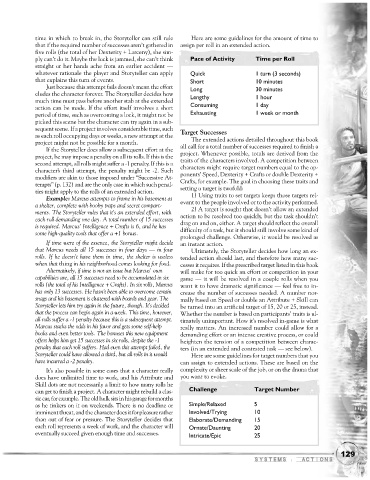
             ply can’t do it. Maybe the lock is jammed, she can’t think  Pace of Activity  Time per Roll
             straight or her hands ache from an earlier accident —
             whatever rationale the player and Storyteller can apply  Quick           1 turn (3 seconds)
             that explains this turn of events.                 Short                 10 minutes
                Just because this attempt fails doesn’t mean the effort  Long         30 minutes
             eludes the character forever. The Storyteller decides how
             much time must pass before another stab at the extended  Lengthy         1 hour
             action can be made. If the effort itself involves a short  Consuming     1 day
             period of time, such as overcoming a lock, it might not be  Exhausting   1 week or month
             picked this scene but the character can try again in a sub-
             sequent scene. If a project involves considerable time, such  Target Successes
             as each roll occupying days or weeks, a new attempt at the
                                                                The extended actions detailed throughout this book
             project might not be possible for a month.      all call for a total number of successes required to finish a
                If the Storyteller does allow a subsequent effort at the
             project, he may impose a penalty on all its rolls. If this is the  project. Whenever possible, totals are derived from the
                                                             traits of the characters involved. A competition between
             second attempt, all rolls might suffer a -1 penalty. If this is a
             character’s third attempt, the penalty might be -2. Such  characters might require target numbers equal to the op-
                                                             ponents’ Speed, Dexterity + Crafts or double Dexterity +
             modifiers are akin to those imposed under “Successive At-
             tempts” (p. 132) and are the only case in which such penal-  Crafts, for example. The goal in choosing these traits and
                                                             setting a target is twofold:
             ties might apply to the rolls of an extended action.
                Example: Marcus attempts to frame in his basement as  1) Using traits to set targets keeps those targets rel-
             a shelter, complete with booby traps and secret compart-  evant to the people involved or to the activity performed.
                                                                2) A target is sought that doesn’t allow an extended
             ments. The Storyteller rules that it’s an extended effort, with  action to be resolved too quickly, but the task shouldn’t
             each roll demanding one day. A total number of 15 successes
             is required. Marcus’ Intelligence + Crafts is 6, and he has  drag on and on, either. A target should reflect the overall
                                                             difficulty of a task, but it should still involve some kind of
             some high-quality tools that offer a +1 bonus.
                                                             prolonged challenge. Otherwise, it would be resolved as
                If time were of the essence, the Storyteller might decide  an instant action.
             that Marcus needs all 15 successes in four days — in four  Ultimately, the Storyteller decides how long an ex-
             rolls. If he doesn’t have them in time, the shelter is useless  tended action should last, and therefore how many suc-
             when that thing in his neighborhood comes looking for food.  cesses it requires. If the prescribed target listed in this book
                Alternatively, if time is not an issue but Marcus’ own  will make for too quick an effort or competition in your
             capabilities are, all 15 successes need to be accumulated in six  game — it will be resolved in a couple rolls when you
             rolls (the total of his Intelligence + Crafts). In six rolls, Marcus  want it to have dramatic significance — feel free to in-
             has only 13 successes. He hasn’t been able to overcome certain  crease the number of successes needed. A number nor-
             snags and his basement is cluttered with boards and gear. The  mally based on Speed or double an Attribute + Skill can
             Storyteller lets him try again in the future, though. It’s decided  be turned into an artificial target of 15, 20 or 25, instead.
             that the process can begin again in a week. This time, however,  Whether the number is based on participants’ traits is ul-
             all rolls suffer a -1 penalty because this is a subsequent attempt.  timately unimportant. How it’s resolved in-game is what
             Marcus stacks the odds in his favor and gets some self-help  really matters. An increased number could allow for a
             books and even better tools. The bonuses this new equipment  demanding effort or an intense creative process, or could
             offers helps him get 15 successes in six rolls, despite the -1  heighten the tension of a competition between charac-
             penalty that each roll suffers. Had even this attempt failed, the  ters (in an extended and contested task — see below).
             Storyteller could have allowed a third, but all rolls in it would  Here are some guidelines for target numbers that you
             have incurred a -2 penalty.                     can assign to extended actions. These are based on the
                It’s also possible in some cases that a character really  complexity or sheer scale of the job, or on the drama that
             does have unlimited time to work, and his Attribute and  you want to evoke.
             Skill dots are not necessarily a limit to how many rolls he
             can get to finish a project. A character might rebuild a clas-  Challenge  Target Number
             sic car, for example. The old hulk sits in his garage for months
             as he tinkers on it on weekends. There is no deadline or  Simple/Relaxed  5
             imminent threat, and the character does it for pleasure rather  Involved/Trying  10
             than out of fear or pressure. The Storyteller decides that  Elaborate/Demanding  15
             each roll represents a week of work, and the character will  Ornate/Daunting  20
             eventually succeed given enough time and successes.
                                                                Intricate/Epic       25

                                                                                                                  129
                                                                                     SYSTEMS- ACTIONS

