


Page 104 - digitalliteracy
P. 104
5.1  Choosing the Appropriate Form of Communication


                              in writing. In the workplace, for example, if you must fire an employee, you should
                              not do so in a letter or e-mail. Rather, you should meet with him or her face-to-face
                              in order to prevent misunderstandings and show respect to someone who is about
                              to receive difficult news.
                            •  When you communicate information that is highly personal or confidential and you
                              do not want it shared with others or kept in writing.
                            •  When you need to discuss a complex issue that might take a lengthy written note to
                              explain. In these instances a face-to-face meeting or a phone conversation is usually
                              your best option.

                       If a personal meeting cannot be held in these circumstances, a videoconference or a tele-
                       phone call is your next best option.


                       Written Communication

                       Most academic and professional communication is written; and written communication cov-
                       ers everything from handwritten notes to instant messages, text messages, e-mail messages,
                       and formal written or typed letters. No matter the medium, written communication typically
                       has two common features: (a) It can be more easily misunderstood than face-to-face commu-
                       nication, and (b) it can be permanent, especially if it is online, where it can be retrieved later
                       and shared with others.

                       Whenever  you put  anything in writ-
                       ing, you may be creating a permanent
                       record of  it. Don’t assume because
                       you deleted an  e-mail  or text  mes-
                       sage that it cannot be retrieved. Elec-
                       tronic communications are  typically
                       backed up in multiple places, such as
                       servers, databases, and cloud storage,
                       the owners of which can access your
                       e-mails. For example, when you send
                       messages through your work account,
                       your employer  can retrieve them at
                       any time. Not to mention, the recipient
                       will have a copy, as well. So a golden                            UberImages/iStock/Thinkstock
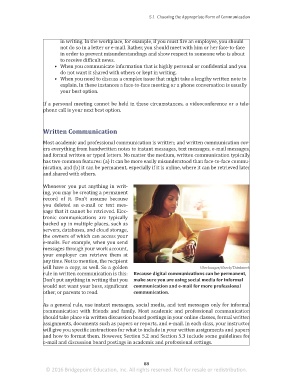
                       rule in written communication is this:  Because digital communications can be permanent,
                       Don’t put anything in writing that you  make sure you are using social media for informal
                       would not want your boss, significant  communication and e-mail for more professional
                       other, or parents to read.            communication.


                       As a general rule, use instant messages, social media, and text messages only for informal
                       communication with friends  and family. Most academic and professional communication
                       should take place via written discussion board postings in your online classes, formal written
                       assignments, documents such as papers or reports, and e-mail. In each class, your instructor
                       will give you specific instructions for what to include in your written assignments and papers
                       and how to format them. However, Section 5.2 and Section 5.3 include some guidelines for
                       e-mail and discussion board postings in academic and professional settings.


                                                                 88
                        © 2016 Bridgepoint Education, Inc. All rights reserved. Not for resale or redistribution.


       sol82612_05_m05_085-096.indd   88                                                                             6/29/16   5:13 PM

