


Page 106 - digitalliteracy
P. 106
5.2  Writing Academic and Professional E-mails


                       Personal Versus Professional E-mails


                       In  academic and professional settings,  e-mail  has
                       become an  essential  communication  tool.  It  is an
                       easy, convenient, and quick form  of  professional
                       communication  when it  is prepared in a  profes-
                       sional manner. In an informal e-mail to a friend, a
                       quick note like “Luv your pics. See u later. :)” may
                       be fine. However, when you write an e-mail to an
                       instructor, staff  member, or  a fellow classmate at
                       school  or  use e-mail  for  business purposes,  the
                       language and the format of your message must be
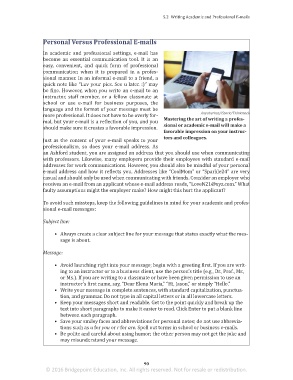
                                                                                         Anyaberkut/iStock/Thinkstock
                       more professional. It does not have to be overly for-
                                                                          Mastering the art of writing a profes-
                       mal, but your e-mail is a reflection of you, and you
                                                                          sional or academic e-mail will make a
                       should make sure it creates a favorable impression.
                                                                          favorable impression on your instruc-
                                                                          tors and colleagues.
                       Just as the content  of your e-mail  speaks to your
                       professionalism, so does  your e-mail  address. As
                       an Ashford student, you are assigned an address that you should use when communicating
                       with professors. Likewise, many employers provide their employees with standard e-mail
                       addresses for work communications. However, you should also be mindful of your personal
                       e-mail address and how it reflects you. Addresses like “CoolMom” or “Sparkle24” are very
                       casual and should only be used when communicating with friends. Consider an employer who
                       receives an e-mail from an applicant whose e-mail address reads, “LoveN21@xyz.com.” What
                       faulty assumptions might the employer make? How might this hurt the applicant?

                       To avoid such missteps, keep the following guidelines in mind for your academic and profes-
                       sional e-mail messages:
                       Subject line:


                            •  Always create a clear subject line for your message that states exactly what the mes-
                              sage is about.

                       Message:

                            •  Avoid launching right into your message; begin with a greeting first. If you are writ-
                              ing to an instructor or to a business client, use the person’s title (e.g., Dr., Prof., Mr.,
                              or Ms.). If you are writing to a classmate or have been given permission to use an
                              instructor’s first name, say, “Dear Elena Maria,” “Hi, Jason,” or simply “Hello.”
                            •  Write your message in complete sentences, with standard capitalization, punctua-
                              tion, and grammar. Do not type in all capital letters or in all lowercase letters.
                            •  Keep your messages short and readable. Get to the point quickly and break up the
                              text into short paragraphs to make it easier to read. Click Enter to put a blank line
                              between each paragraph.
                            •  Save your smiley faces and abbreviations for personal notes; do not use abbrevia-
                              tions such as u for you or r for are. Spell out terms in school or business e-mails.
                            •  Be polite and careful about using humor; the other person may not get the joke and
                              may misunderstand your message.


                                                                 90
                        © 2016 Bridgepoint Education, Inc. All rights reserved. Not for resale or redistribution.


       sol82612_05_m05_085-096.indd   90                                                                             6/29/16   5:13 PM

