


Page 198 - digitalliteracy
P. 198
9.2  Credit Cards: A Tool, Not a Crutch


                       Before Elena Maria decided to get control over her
                       money, she made a number of expensive mistakes
                       that  taught her  some  valuable lessons.  Five years
                       ago, Elena Maria found a beautiful dress at a depart-
                       ment store. The dress was perfect for her cousin’s
                       upcoming wedding. It was not on sale, but the store
                       had only one in her size. When she tried it on, her
                       sister said she looked like a model and urged her to
                       buy the dress. Elena Maria hesitated but ultimately
                       couldn’t resist. The dress cost $350, matching shoes
                       were $120, and an evening bag was $85, for a total
                       outfit price of $555.

                       Elena Maria decided to use her department store
                       credit card to pay for the dress. Unfortunately, when
                       the bill  arrived,  Elena  Maria could only make the
                       minimum  payment.  Her  department  store credit
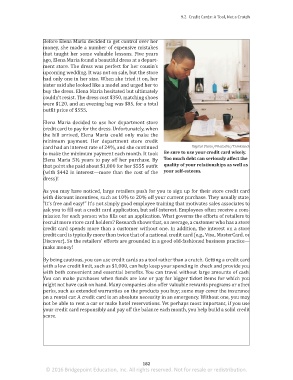
                       card had an interest rate of 24%, and she continued           Digital Vision/Photodisc/Thinkstock
                       to make the minimum payment each month. It took    Be sure to use your credit card wisely.
                       Elena Maria 5½ years to pay off her purchase. By   Too much debt can seriously affect the
                       that point she paid about $1,000 for her $555 outfit   quality of your relationships as well as
                       (with $442 in interest—more than the cost of the   your self-esteem.
                       dress)!

                       As you may have noticed, large retailers push for you to sign up for their store credit card
                       with discount incentives, such as 10% to 20% off your current purchase. They usually state,
                       “It’s free and easy!” It’s not simply good employee training that motivates sales associates to
                       ask you to fill out a credit card application, but self-interest. Employees often receive a com-
                       mission for each person who fills out an application. What governs the efforts of retailers to
                       recruit more store card holders? Research shows that, on average, a customer who has a store
                       credit card spends more than a customer without one. In addition, the interest on a store
                       credit card is typically more than twice that of a national credit card (e.g., Visa, MasterCard, or
                       Discover). So the retailers’ efforts are grounded in a good old-fashioned business practice—
                       make money!

                       By being cautious, you can use credit cards as a tool rather than a crutch. Getting a credit card
                       with a low credit limit, such as $1,000, can help keep your spending in check and provide you
                       with both convenient and essential benefits. You can travel without large amounts of cash.
                       You can make purchases when funds are low or pay for bigger ticket items for which you
                       might not have cash on hand. Many companies also offer valuable rewards programs or other
                       perks, such as extended warranties on the products you buy; some may cover the insurance
                       on a rental car. A credit card is an absolute necessity in an emergency. Without one, you may
                       not be able to rent a car or make hotel reservations. Yet perhaps most important, if you use
                       your credit card responsibly and pay off the balance each month, you help build a solid credit
                       score.


                                                                 182
                        © 2016 Bridgepoint Education, Inc. All rights reserved. Not for resale or redistribution.


       sol82612_09_m09_171-194.indd   182                                                                            6/29/16   5:19 PM

