


Page 193 - digitalliteracy
P. 193
9.1  Responsible Borrowing


                            •  The Federal Perkins Loan

                              Program provides low-
                              interest loans available for
                              students with extraordinary
                              need through some 1,700
                              participating postsecondary
                              institutions.
                            •  If you do not qualify for a
                              Perkins loan, you can apply
                              for a Direct Subsidized Loan
                              through the Federal Direct
                              Loan Program, for which you
                              must meet less-stringent
                                                                                           Creatas/Creatas/Thinkstock
                              income guidelines.
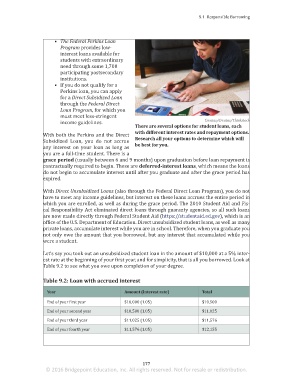
                                                              There are several options for student loans, each
                                                              with different interest rates and repayment options.
                       With both the Perkins and the Direct
                                                              Research all your options to determine which will
                       Subsidized  Loan,  you  do  not  accrue
                                                              be best for you.
                       any interest on your loan  as  long  as
                       you are a full-time student. There is a
                       grace period (usually between 6 and 9 months) upon graduation before loan repayment is
                       contractually required to begin. These are deferred-interest loans, which means the loans
                       do not begin to accumulate interest until after you graduate and after the grace period has
                       expired.

                       With Direct Unsubsidized Loans (also through the Federal Direct Loan Program), you do not
                       have to meet any income guidelines, but interest on these loans accrues the entire period in
                       which you are enrolled, as well as during the grace period. The 2010 Student Aid and Fis-
                       cal Responsibility Act eliminated direct loans through guaranty agencies, so all such loans
                       are now made directly through Federal Student Aid (https://studentaid.ed.gov), which is an
                       office of the U.S. Department of Education. Direct unsubsidized student loans, as well as many
                       private loans, accumulate interest while you are in school. Therefore, when you graduate you
                       not only owe the amount that you borrowed, but any interest that accumulated while you
                       were a student.

                       Let’s say you took out an unsubsidized student loan in the amount of $10,000 at a 5% inter-
                       est rate at the beginning of your first year, and for simplicity, that is all you borrowed. Look at
                       Table 9.2 to see what you owe upon completion of your degree.
 As you are aware, this valuable investment in yourself comes with a price tag. Few people are
 able to pay for their education outright and therefore must take out student loans. It is impor-  Table 9.2: Loan with accrued interest
 tant to understand the types of loans that are available because each one will have a different
                         Year                            Amount (interest rate)           Total
 impact on your financial future. As you now know, interest plays a major role in how much
 you repay in the long term.
                         End of your first year          $10,000 (1.05)                   $10,500
                         End of your second year         $10,500 (1.05)                   $11,025
 Types of Student Loans  End of your third year          $11,025 (1.05)                   $11,576

 If possible, you want to obtain a federal loan (as opposed to a private loan) primarily because   End of your fourth year  $11,576 (1.05)  $12,155
 it costs less and has better repayment options. Federal student loans are available from the
 Federal Perkins Loan Program and the Federal Direct Loan Program:


                                                                 177
                        © 2016 Bridgepoint Education, Inc. All rights reserved. Not for resale or redistribution.


       sol82612_09_m09_171-194.indd   177                                                                            6/29/16   5:19 PM

