


Page 195 - digitalliteracy
P. 195
9.1  Responsible Borrowing


                       Isabel now pays $250 per month toward her student loan debt. She has a Direct Subsidized
                       Loan, so no interest accumulated during her time in college. She even had a 6-month interest-
                       free grace period after she graduated before she had to start repayment. Yet she will be paying
                       on this loan for many years to come, and she will pay much more than if she had only bor-
                       rowed what she needed for school expenses.

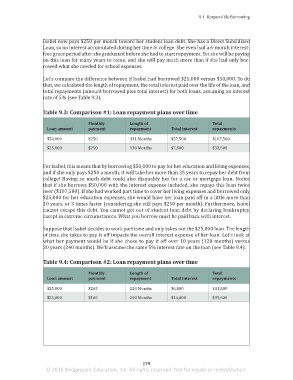
                       Let’s compare the difference between if Isabel had borrowed $25,000 versus $50,000. To do
                       that, we calculated the length of repayment, the total interest paid over the life of the loan, and
                       total repayments (amount borrowed plus total interest) for both loans, assuming an interest
                       rate of 5% (see Table 9.3).

                       Table 9.3: Comparison #1: Loan repayment plans over time

                                          Monthly          Length of                          Total
                         Loan amount      payment          repayment         Total interest   repayments
                         $50,000          $250             431 Months        $57,500          $107,500

                         $25,000          $250             130 Months        $7,500           $32,500


                       For Isabel, this means that by borrowing $50,000 to pay for her education and living expenses,
                       and if she only pays $250 a month, it will take her more than 35 years to repay her debt from
                       college! Having so much debt could also disqualify her for a car or mortgage loan. Notice
                       that if she borrows $50,000 with the interest expense included, she repays this loan twice
                       over ($107,500). If she had worked part time to cover her living expenses and borrowed only
                       $25,000 for her education expenses, she would have her loan paid off in a little more than
                       10 years, or 3 times faster (considering she still pays $250 per month). Furthermore, Isabel
                       cannot escape this debt. You cannot get out of student loan debt by declaring bankruptcy,
                       except in extreme circumstances. What you borrow must be paid back with interest.

                       Suppose that Isabel decides to work part time and only takes out the $25,000 loan. The length
                       of time she takes to pay it off impacts the overall interest expense of her loan. Let’s look at
                       what her payment would be if she chose to pay it off over 10 years (120 months) versus
                       20 years (240 months). We’ll assume the same 5% interest rate on the loan (see Table 9.4).

                       Table 9.4: Comparison #2: Loan repayment plans over time

                                          Monthly          Length of                          Total
                         Loan amount      payment          repayment         Total interest   repayments


                         $25,000          $265             120 Months        $6,800           $31,800
                         $25,000          $165             240 Months        $14,600          $39,600


                                                                 179
                        © 2016 Bridgepoint Education, Inc. All rights reserved. Not for resale or redistribution.


       sol82612_09_m09_171-194.indd   179                                                                            6/29/16   5:19 PM

