


Page 104 - ArithBook5thEd ~ BCC
P. 104
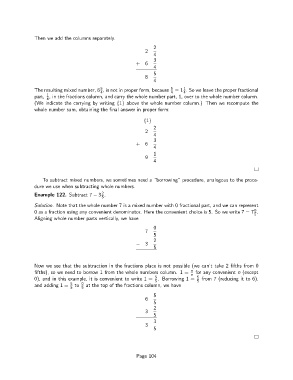
Then we add the columns separately.

                                                                 2
                                                              2
                                                                 4
                                                                 3
                                                          +   6
                                                                 4
                                                                 5
                                                              8
                                                                 4
                                                                              1
                                           5
               The resulting mixed number, 8 , is not in proper form, because  5 4  =1 . So we leave the proper fractional
                                           4
                                                                              4
                     1
               part, , in the fractions column, and carry the whole number part, 1, over to the whole number column.
                     4
               (We indicate the carrying by writing {1} above the whole number column.) Then we recompute the
               whole number sum, obtaining the final answer in proper form:
                                                             {1}
                                                                 2
                                                              2
                                                                 4
                                                                 3
                                                          +   6
                                                                 4
                                                                 1
                                                              9
                                                                 4


                   To subtract mixed numbers, we sometimes need a “borrowing” procedure, analogous to the proce-
               dure we use when subtracting whole numbers.
                                            2
               Example 122. Subtract 7 − 3 .
                                            5
               Solution. Note that the whole number 7 is a mixed number with 0 fractional part, and we can represent
                                                                                                           0
               0 as a fraction using any convenient denominator. Here the convenient choice is 5. So we write 7 = 7 .
                                                                                                           5
               Aligning whole number parts vertically, we have
                                                                 0
                                                              7
                                                                 5
                                                                 2
                                                          −   3
                                                                 5


               Now we see that the subtraction in the fractions place is not possible (we can’t take 2 fifths from 0
               fifths), so we need to borrow 1 from the whole numbers column. 1 =  n n  for any convenient n (except
                                                                  5
               0), and in this example, it is convenient to write 1 = . Borrowing 1 =  5 5  from 7 (reducing it to 6),
                                                                  5
               and adding 1 =  5  to  0  at the top of the fractions column, we have
                              5    5
                                                                 5
                                                              6
                                                                 5
                                                                 2
                                                          −   3
                                                                 5
                                                                 3
                                                              3
                                                                 5


                                                          Page 104

