


Page 100 - ArithBook5thEd ~ BCC
P. 100
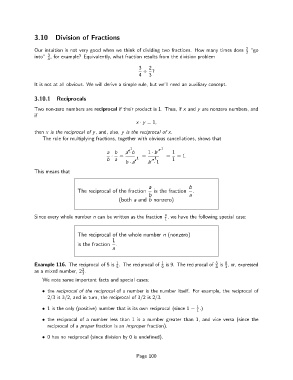
3.10     Division of Fractions

               Our intuition is not very good when we think of dividing two fractions. How many times does  2 3  “go
                     3
               into” , for example? Equivalently, what fraction results from the division problem
                     4
                                                           3   2
                                                             ÷ ?
                                                           4   3
               It is not at all obvious. We will derive a simple rule, but we’ll need an auxiliary concept.


               3.10.1    Reciprocals

               Two non-zero numbers are reciprocal if their product is 1. Thus, if x and y are nonzero numbers, and
               if
                                                          x · y =1,

               then x is the reciprocal of y,and, also, y is the reciprocal of x.
                   The rule for multiplying fractions, together with obvious cancellations, shows that
                                                       1            1
                                              a b    '✒ a · b  1 · ✚ b ✚❃  1
                                                ·  =        =          =   =1.
                                              b  a        1     ✚❃ 1     1
                                                     b · '✒ a  ✚ b · 1
               This means that


                                                               a                b
                                 The reciprocal of the fraction  is the fraction  .
                                                               b                a
                                                   (both a and b nonzero)


                                                                      n
               Since every whole number n can be written as the fraction ,we have the following special case:
                                                                      1
                                 The reciprocal of the whole number n (nonzero)
                                                1
                                 is the fraction  .
                                                n


                                                                                               8
                                                  1
               Example 116. The reciprocal of 5 is . The reciprocal of  1 9  is 9. The reciprocal of  3 8  is , or, expressed
                                                                                               3
                                                  5
                                   2
               as a mixed number, 2 .
                                   3
                   We note some important facts and special cases:
                   • the reciprocal of the reciprocal of a number is the number itself. For example, the reciprocal of
                     2/3is 3/2, and in turn, the reciprocal of 3/2is 2/3.
                                                                                   1
                   • 1 is the only (positive) number that is its own reciprocal (since1 = .)
                                                                                   1
                   • the reciprocal of a number less than 1 is a number greater than 1, and vice versa (since the
                     reciprocal of a proper fraction is an improper fraction).

                   • 0 has no reciprocal (since division by 0 is undefined).


                                                          Page 100

