


Page 101 - ArithBook5thEd ~ BCC
P. 101
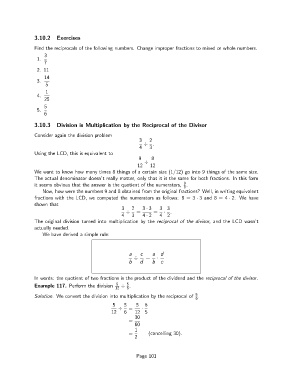
3.10.2    Exercises

               Find the reciprocals of the following numbers. Change improper fractions to mixed or whole numbers.
                    3
                1.
                    7
                2. 11
                    14
                3.
                    5
                    1
                4.
                    25
                    5
                5.
                    6

               3.10.3    Division is Multiplication by the Reciprocal of the Divisor

               Consider again the division problem
                                                           3   2
                                                             ÷ .
                                                           4   3
               Using the LCD, this is equivalent to
                                                           9    8
                                                             ÷
                                                          12    12
               We want to know how many times 8 things of a certain size (1/12) go into 9 things of the same size.
               The actual denominator doesn’t really matter, only that it is the same for both fractions. In this form
                                                                              9
               it seems obvious that the answer is the quotient of the numerators, .
                                                                              8
                   Now, how were the numbers 9 and 8 obtained from the original fractions? Well, in writing equivalent
               fractions with the LCD, we computed the numerators as follows: 9 =3 · 3and 8 = 4 · 2. We have
               shown that
                                                    3   2    3 · 3  3 3
                                                      ÷   =      =    · .
                                                    4   3    4 · 2  4 2
               The original division turned into multiplication by the reciprocal of the divisor,and the LCD wasn’t
               actually needed.
                   We have derived a simple rule:


                                                       a    c    a d
                                                         ÷    =    ·
                                                       b    d    b c


               In words: the quotient of two fractions is the product of the dividend and the reciprocal of the divisor.
                                                      5
               Example 117. Perform the division  5  ÷ .
                                                 12   6
                                                                                   5
               Solution. We convert the division into multiplication by the reciprocal of .
                                                                                   6
                                                5    5    5   6
                                                  ÷    =    ·
                                                12   6   12 5
                                                         30
                                                       =
                                                         60
                                                         1
                                                       =       (cancelling 30).
                                                         2


                                                          Page 101

