


Page 136 - ArithBook5thEd ~ BCC
P. 136
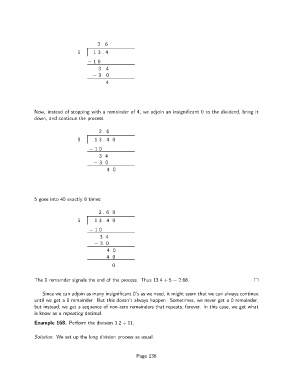
2. 6
                                  5     13 . 4

                                      − 10
                                          3  4
                                        − 30
                                             4


               Now, instead of stopping with a remainder of 4, we adjoin an insignificant 0 to the dividend, bring it
               down, and continue the process:


                                          2. 6
                                  5      13 . 4 0
                                      − 10
                                          34
                                        − 30
                                              40


               5goes into 40exactly 8times:


                                          2. 6 8
                                  5      13 . 4 0
                                      − 10
                                           34
                                        − 30
                                              40
                                          − 40
                                                0


               The 0 remainder signals the end of the process. Thus 13.4 ÷ 5= 2.68.


                   Since we can adjoin as many insignificant 0’s as we need, it might seem that we can always continue
               until we get a 0 remainder. But this doesn’t always happen. Sometimes, we never get a 0 remainder,
               but instead, we get a sequence of non-zero remainders that repeats, forever. In this case, we get what
               is know as a repeating decimal.

               Example 168. Perform the division 3.2 ÷ 11.

               Solution. We set up the long division process as usual.


                                                          Page 136

