


Page 15 - ArithBook5thEd ~ BCC
P. 15
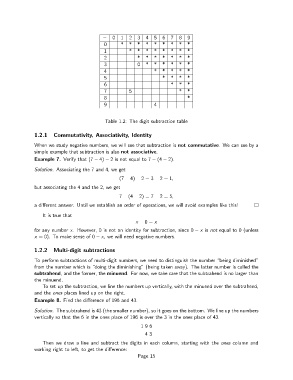
−   0   1  2  3   4  5   6  7   8  9
                                             0      *  *  *   *  *   *  *   *  *
                                             1         *  *   *  *   *  *   *  *
                                             2            *   *  *   *  *   *  *
                                             3            0   *  *   *  *   *  *
                                             4                   *   *  *   *  *
                                             5                       *  *   *  *
                                             6                          *   *  *
                                             7         5                    *  *
                                             8                                 *
                                             9                   4


                                             Table 1.2: The digit subtraction table


               1.2.1   Commutativity, Associativity, Identity
               When we study negative numbers, we will see that subtraction is not commutative.We can see by a
               simple example that subtraction is also not associative.
               Example 7. Verify that (7 − 4) − 2is not equal to 7 − (4 − 2).

               Solution. Associating the 7 and 4, we get
                                                   (7 − 4) − 2= 3 − 2= 1,
               but associating the 4 and the 2, we get
                                                   7 − (4 − 2) = 7 − 2= 5,

               a different answer. Until we establish an order of operations, we will avoid examples like this!

                   It is true that
                                                          x − 0= x
               for any number x. However, 0 is not an identity for subtraction, since 0 − x is not equal to 0 (unless
               x =0). To make sense of 0 − x, we will need negative numbers.


               1.2.2   Multi-digit subtractions
               To perform subtractions of multi-digit numbers, we need to distinguish the number “being diminished”
               from the number which is “doing the diminishing” (being taken away). The latter number is called the
               subtrahend, and the former, the minuend. For now, we take care that the subtrahend is no larger than
               the minuend.
                   To set up the subtraction, we line the numbers up vertically, with the minuend over the subtrahend,
               and the ones places lined up on the right.
               Example 8. Find the difference of 196 and 43.
               Solution. The subtrahend is 43 (the smaller number), so it goes on the bottom. We line up the numbers
               vertically so that the 6 in the ones place of 196 is over the 3 in the ones place of 43.
                                                            19 6
                                                              43

                   Then we draw a line and subtract the digits in each column, starting with the ones column and
               working right to left, to get the difference:
                                                           Page 15

