


Page 11 - ArithBook5thEd ~ BCC
P. 11
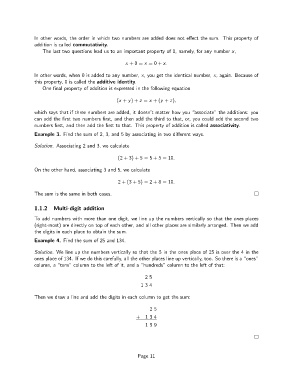
In other words, the order in which two numbers are added does not effect the sum. This property of
               addition is called commutativity.
                   The last two questions lead us to an important property of 0, namely, for any number x,

                                                     x +0 = x =0 + x.

               In other words, when 0 is added to any number, x, you get the identical number, x,again. Because of
               this property, 0 is called the additive identity.
                   One final property of addition is expressed in the following equation


                                                  (x + y)+ z = x +(y + z),

               which says that if three numbers are added, it doesn’t matter how you “associate” the additions: you
               can add the first two numbers first, and then add the third to that, or, you could add the second two
               numbers first, and then add the first to that. This property of addition is called associativity.
               Example 3. Find the sum of 2, 3, and 5 by associating in two different ways.

               Solution. Associating 2 and 3, we calculate

                                                  (2 + 3) + 5 = 5 + 5 = 10.


               On the other hand, associating 3 and 5, we calculate

                                                  2+ (3+ 5) = 2 + 8 = 10.

               The sum is the same in both cases.


               1.1.2   Multi-digit addition
               To add numbers with more than one digit, we line up the numbers vertically so that the ones places
               (right-most) are directly on top of each other, and all other places are similarly arranged. Then we add
               the digits in each place to obtain the sum.
               Example 4. Find the sum of 25 and 134.

               Solution. We line up the numbers vertically so that the 5 in the ones place of25 is over the 4 in the
               ones place of 134. If we do this carefully, all the other places line up vertically, too. So there is a “ones”
               column, a “tens” column to the left of it, and a “hundreds” column to the left of that:


                                                              25
                                                            13 4

               Then we draw a line and add the digits in each column to get the sum:

                                                                25
                                                          +1 3 4
                                                              159


                                                           Page 11

